Systematic Integration: What Hegel Could Have Done with Darwin
This text is a preview of History of the Reception of Hegel, volume I, to be published in 2026 by Reflexivity Press.
Had Hegel read Darwin—and one may assume he would have, since Hegel engaged intensively with the natural sciences of his time (Goethe, Oersted, Cuvier)—he would not have rejected evolutionary theory, but integrated it. Not materialistically like Haeckel, not moralistically like Spencer. But as a moment within the system.
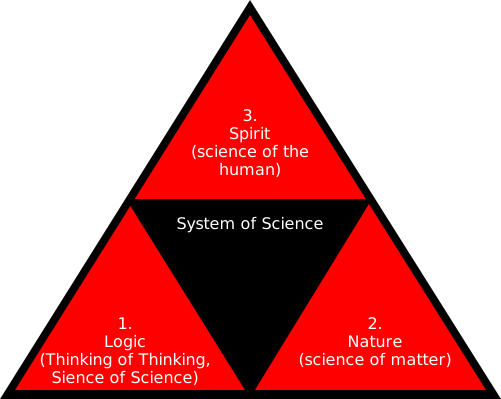
The integration would have been possible because Hegel’s philosophy of nature already distinguishes two orders:
1. The logical order: mechanics -> physics -> chemistry -> life. This is the systematic organization according to conceptual stages. It shows which structures conceptually build upon one another. Life presupposes chemism, chemism presupposes physics, physics presupposes mechanics. This order is not temporal, but conceptual. It shows relations of dependency, not historical sequence.
2. The phenomenal order: what we find in nature—stones, plants, animals. These are factually given, not deduced from concepts. Hegel was aware that the philosophy of nature presupposes the empirical sciences rather than replacing them. Philosophy orders what the sciences supply.[8]
Darwin now adds a third order:
3. The historical order: the temporal emergence of life forms through evolution. This is neither purely conceptual (like the logical order) nor merely factual-given (like the phenomenal order), but processual. It shows how the more complex arises out of the simpler—not through conceptual necessity, but through natural mechanisms over long stretches of time.
The Hegelian integration would run as follows: evolution is the temporal realization of the logical sequence of stages under contingent conditions. Nature necessarily brings forth life—but not necessarily these particular life forms. The structure (life as self-organization, as inner purpose) is conceptually necessary. The concrete shapes (dinosaurs, mammals, humans) are contingent—the result of variation and selection under respective environmental conditions.
The central principle: evolution shows structural directedness with contingent forms. There is a trend toward higher complexity, toward stronger self-organization, toward more elaborate forms of information processing. Single-celled organisms develop into multicellular ones, simple nervous systems into brains, reflexes into consciousness. This trend is not chance. It follows from the conditions of evolution itself: more complex systems can cope with more complex environments, have more possibilities for adaptation. But the path to higher complexity is open. There is no pre-programming, no plan. Evolution invents its solutions within the process itself.[9]
This position differs fundamentally from three alternatives:
Against Michelet: Evolution is not merely the conceptual unfolding of a pre-existing Idea. Concrete life forms arose historically, not through logical derivation. Dinosaurs are not a concept, but the result of contingent evolutionary processes.
Against Haeckel: Evolution shows no linear progress toward ever “higher” forms. There is no hierarchy of races. Complexity is not identical with worth. A bacterium is perfectly adapted to its niche—not “lower” than a mammal.
Against reductionism: Evolution is not merely a material mechanism. It brings forth qualitatively new structural levels—life, consciousness, self-consciousness. These are not reducible to physics and chemistry, although they presuppose them. Emergence is real.[10]
Spirit would then be understood as a product of nature that transcends nature. Evolution creates the conditions for reason, freedom, morality—but these are not reducible to evolutionary fitness. The human being can act against biological impulses, can set purposes for itself, can know and shape nature. This distinguishes it from the animal—not gradually (more intelligent adaptation), but qualitatively (self-conscious teleology). The animal has an inner purpose (the organism preserves itself), but unconsciously. The human being knows its purposes, can reflect on them, revise them, set new ones.[11]
This integration would have been Hegel’s answer: the philosophy of nature as a theory of structure, not as historical reconstruction. The logical order shows which structures are conceptually connected. The historical order (evolution) shows how these structures factually arose. Together, both yield a complete picture. Without concepts, evolution remains blind—a mere collection of facts without understanding. Without history, concepts remain empty—speculative construction without empirical basis.