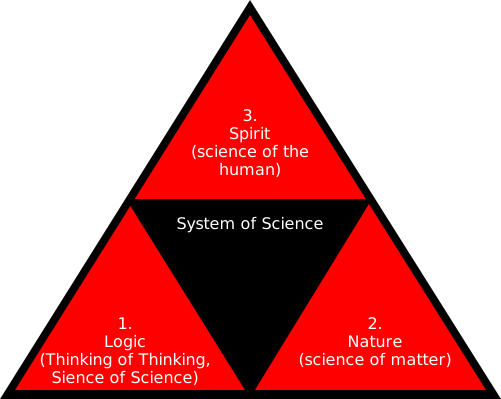
Commentary on the Logic, Chapter 15
The Systematic Contrast
| Form | Determined by | Causality | Time structure |
|---|---|---|---|
| Mechanism | Past (cause -> effect) | Linear, blind | Past -> present |
| Chemism | Mutual affinity | Reciprocal, transformative | Simultaneous |
| Teleology | Anticipated end | End determines beginning | The represented purpose orders the present means |
Teleology overcomes the limit of chemism: here a purpose organizes the material. At first it remains external to the material — it becomes an inner purpose only at the end of this movement, in the transition to life. This is not something consciousness decides. A clarification is needed here, or two distinctions will collapse into one another. The series of objectivity moves from external to internal purposiveness — that is the distinction that matters: in teleology, purpose and material stand separate; in life, the purpose is immanent to the object. Whether consciousness is involved in this is not logically decisive. The “subjective purpose” is a logical determination, not a psychological finding, and an organism need not know its purpose in order to be an inner purpose.
Only in spirit does the reflected positing of purpose enter — the intentio, the explicit “I set myself this purpose.” That is a third stage, not the definition of the first. Whoever distinguishes teleology and life by way of consciousness misses precisely the transition that is at stake here: teleology leads to life because inner purposiveness is possible without consciousness. [KF]
| Stage | Purpose structure | Consciousness |
|---|---|---|
| Teleology | external purpose | logically not decisive |
| Life | inner purpose, self-purpose | not required |
| Spirit | reflected positing of purpose | intentio |
Mechanical motion does not belong here: Hegel determines gravity and fall within mechanism. Further reading: Stekeler works out this distinction through linguistic analysis.[1]
The Three Moments of the Purpose
Logical teleology describes the structure of external purposiveness; its paradigmatic realization is purposive action. Structures of internal purposiveness first appear in life — nature does not belong in this column here, because a directed dynamic is not yet the positing of a purpose. [KF]
| Moment | Description | Example (house-building) |
|---|---|---|
| Subjective purpose | Idea, not yet realized | “I want to build a house” |
| Means | The purpose objectifies itself in the instrument | Bricks, tools, workers |
| Realized purpose | Idea and actuality united | The finished house |
Hegel on the means: “the plow is more honorable than are immediately the enjoyments which it procures and which are ends” (TWA 6, 453). The means is more enduring than the realized purpose — the plowshare outlasts the harvests it made possible. The instrument preserves the human purpose beyond the individual instance of use. The deficiency of the means: it is resistant — the hammer has its weight, the wood its grain. The purpose must respect the inherent logic of the means.
What appears here as logical structure is at the same time the basic form of human labor: whoever works posits a purpose for themselves, chooses means, and thereby changes three natures at once — external nature, society, and themselves. [[kapitalismus-einfuehrung:2]] (optional) develops this without logical presuppositions. And because the means is more enduring than the individual purpose, it becomes the bearer of history: tools, procedures, and institutions hand down positings of purpose that no one still specifically intends.
Hegel states what teleology takes over from the two preceding forms, and it is not a mere addition: the teleological relation “is the unity of mechanism and chemism. The purpose is once again, like the mechanical object, a totality closed within itself, yet enriched by the principle of difference that emerged in chemism.”[2]
From mechanism, then, the purpose has closure — it is a whole unto itself, not dependent on another in order to be what it is. From chemism it has difference — it relates to an object that stands over against it. Both together make it capable of action: only what is determined within itself can have a purpose; only what directs itself toward something else can carry it out.
To this, a warning from the same tradition: mechanism is “also that category which first presents itself to reflection when it considers the objective world” — and at which reflection is glad to stop. That is the diagnosis which Chapter 14 had turned to practical use, in Hegel’s own words.[2:1]
The Cunning of Reason
The purpose does not assert itself directly but sets objects to work against one another: “Reason is as cunning as it is powerful” (Encyclopedia, Vol. 1, §209 Addition). It presses mechanical and chemical processes into its service without wearing itself down in the process. Carry this out for yourself: The farmer wants grain. He does not plow with his bare hands but yokes the ox to the plow. The ox follows its own forces (muscular strength, hunger for the fodder at the end of the furrow) — the farmer uses these forces for his purpose without expending himself. This is the cunning: the means work according to their own laws, but the result serves the purpose.
The lecture transcripts make explicit a determination that is easily overlooked in the printed text: what cunning costs is the means. Correvon’s 1824 transcript notes: “The external means is given up, and the purpose is realized precisely in this giving-up.”[3] Kehler’s 1825 transcript puts it more sharply: “the means is used up, because the purpose has to do with external objectivity, the material is worked on, altered.”[4] And Rolin’s 1829 transcript names the relation: “The means is thus immediately subjected to the purpose.”[5]
This is the logical structure — and it is harmless precisely as long as the means is an ox or a plow. As soon as human beings are the means, the same statement describes something else. Hegel himself does not draw this consequence at this point; it is redeemed in the Philosophy of Right and in the critique of capitalism, where the system of needs presses those who labor into service as means. Cf. [[kapitalismus-einfuehrung:15]] (optional). [KF]
Counter-test: Does talk of “cunning” hold up at all? It presupposes a reason that plans something. Soberly stated, the figure says only this: a purpose achieves more when it makes use of the means’ own lawfulness instead of working against it. This is not metaphysics but the basic form of every technique. Where the formula claims, beyond this, that history pursues purposes that no one has set, it is exactly the mystification that Marx criticizes in Hegel.
The figure has an uncomfortable underside as soon as the means is a human being. Whoever presses the forces of others into service for his own purposes without coercing them — because their own interests already move them in this direction anyway — practices the same cunning. Whether this is cooperation or exploitation is decided not by the structure but by whether the others have a say in determining the purpose. [[kapitalismus-einfuehrung]] (optional) works this out with respect to wage labor. The plow wears down, the ox tires — but the farmer’s plan remains untouched and can be repeated tomorrow. The gravity of water drives the mill, the expansion of steam drives the engine — in both cases the purpose makes use of natural forces that want nothing at all on their own, and coordinates them so that its result comes about. In the social realm: Adam Smith’s invisible hand is one (incomplete) version of the cunning of reason — the self-interests of market participants are coordinated by the market so that (ideally) a result comes about that none of the individuals intended.
The dialectical underside of cunning: The means’ own lawfulness, which the purpose exploits, can turn against the purpose. The technology that human beings develop in order to dominate nature begins in turn to dominate human beings. And Marx shows the sharpest form of this: money, which in simple exchange (C-M-C) serves as a neutral means between use values, becomes, in the capitalist form (M-C-M′), an end in itself — the money that was supposed to be deployed as a means for the satisfaction of human needs becomes the standard to which everything must subordinate itself. Precisely because money abstracts from concrete use values, it can become autonomous and bury beneath itself the purposes it was supposed to serve. This is not a misapplication of the cunning of reason. Rather, in the extension undertaken here, a dialectical underside of Hegel’s analysis of the means comes to light: [KF] the means’ own lawfulness, which makes it useful, is at the same time what makes it dangerous. The logic supplies here the instruments for the critique — teleology shows why this inversion is structurally possible, not merely the product of ill will.
External and Internal Purposiveness
External purposiveness: The end comes from outside — a tool serves a user. Hegel’s sharp critique of utilitarian thinking: to regard everything merely as a means fails to grasp what has purpose in itself. Nature does not exist for human beings. Other human beings do not exist for our purposes. The Enlightenment turned everything into means — and thereby entangled itself in a contradiction: what are means, means to, if there is no end-in-itself?
Internal purposiveness: The organism is an end to itself. It is not a means to something else but organizes itself. Every organ serves the whole, and the whole serves every organ — end and means coincide. This is the transition to the Idea of life.
The practical consequence of this distinction: Where a relation is set up such that human beings figure in it only as means, this is not a moral failing of individuals but a structure of external purposiveness. Hegel’s philosophy of right does not begin from such a structure: the person contains from the outset the claim to be recognized as free. The problem arises only because this recognition initially remains abstract and does not yet contain the conditions of its own realization — the movement from abstract right through morality to ethical life ([[hegel-recht]] (optional)). The recognition of others as ends in themselves — and what happens when an order systematically prevents this — is developed in [[kapitalismus-einfuehrung]] (optional).
Teleology, Freedom, and History — An Important Clarification
A widespread misunderstanding claims that Hegel holds a teleological philosophy of history, in which a world spirit realizes itself through history and human beings are mere instruments of a cosmic process. If this were Hegel’s position, it would be a philosophy of unfreedom. But the teleology we have developed here is a category of objectivity — it shows the logical structure of purposive processes, no more and no less. It says nothing about who sets the ends, which ends are legitimate, or whether there is a cosmic final end. The decisive point: someone who understands what teleology is, is no longer at its mercy. He can ask: Are my ends my own ends — or have I taken them over unreflectively? This, precisely, is freedom, not unfreedom.
System and Enactment — Heinrichs’ Dual Perspective in Detail
| Form | As System | As Enactment |
|---|---|---|
| Mechanism | Machine, agency, infrastructure | Routine, transport, rule execution |
| Chemism | Ecosystem, market, social network | Reaction, exchange, dialogue |
| Teleology | Organism, organization, project | Acting, working, planning |
Anyone who wants to change a system must keep both sides in view. Changing the structure alone (new organizational charts) is not enough — the enactment must change too (new practices). And conversely: wanting to change only behavior, without touching the structures, remains ineffective.
Stekeler reads the doctrine of objectivity in terms of action theory[6] — not as natural stages, but as forms of explanation:
| Form | Stekeler’s Reading | Our Extension |
|---|---|---|
| Mechanism | Rule-governed action without understanding | Also pre-linguistic structures |
| Chemism | Logic of personal roles (father/child, buyer/seller) | Also pre-linguistic affinities |
| Teleology | Logic of labor and the tool | Also non-linguistic forms of purpose-setting |
Where we agree: Stekeler’s de-ontologization is valuable — the forms are logical structures, not naive natural stages. Where we extend his view: Stekeler’s focus on linguistically mediated practices is one-sided. Pre-linguistic beings, too, display these structures — language is decisive for the full form, but not for every instance of it.
Interfaces and Category Errors — Reality Is Complex
Almost all real systems display multiple forms at once. A company is mechanical (infrastructure, accounting), chemical (team dynamics, corporate culture), and teleological (strategy, vision) — at different levels, at different times. The ability to recognize which form dominates at which level prevents category errors: Treating social systems mechanically (“If we just get the structure right…”) forgets that people are not gears. Interpreting mechanical systems teleologically (“Nature has a plan”) forgets that evolution is not a conscious designer. Reducing teleological systems to chemistry (“Consciousness is just chemistry”) misses emergence. Most problems arise at interfaces — where different system logics meet. Invest in interfaces, not just in components.
The Limit of Objectivity — Transition to the Idea
What has objectivity accomplished? The concept is not in the head and reality out there — the categorial structures show themselves in the experience of objectivity. The highest form — inner purposiveness — shows a system that is its own end. What is still missing? Not consciousness — that would be the same error against which 16.1 warns. The reason lies in the separation itself, and it has a shape already known from the logic of being: as long as purpose and object remain external to one another, a bad infinity arises between finite purposiveness and finite objectivity.[7] Every purpose attained becomes the means to the next one, every result calls forth a further one, and the series never comes to itself. The house stands, and one needs a roof, and for the roof, tiles, and for the tiles, a kiln.
This is not a moral objection to busyness, but a logical one: a series that does not break off determines nothing. But where the purpose is immanent to the object, it ends — not because it is exhausted, but because it runs back into itself.
The Idea resolves exactly this: here the purpose is immanent to the object. The organs are not means that get used up, but moments that preserve the connection which preserves them. That the organism does not know this changes nothing about it — knowledge is only added later, in spirit.
The categorial leap to the Idea: the objects of the doctrine of objectivity exist for another — the planet revolves around the sun, but not for itself. Life relates to itself. It is its own end: its processes serve its own preservation. The self- is not a mystical addition, but a structural quality. A system with self-relation is no longer merely object, but subject — relating to itself, striving for itself, acting out of itself. The Idea then unfolds in three stages: Life (immediate unity, unconscious), Cognition and Willing (divided unity, conscious but split), the absolute Idea (unity known, the method becoming conscious of itself).
Review: Objectivity as a Sequence of Stages
| Mechanism | Chemism | Teleology | |
|---|---|---|---|
| Form of relation | External, indifferent | Constitutive, polar | Purposive, organized |
| Form of reflection | ≈ Positing (tautology) | ≈ External (difference) | ≈ Determining (integration) |
| Form of resistance | Object as obstacle | Object as complement | Object as material |
| Deficiency | No selectivity | Product is dead | Purpose can be missed |
| Gain | Self-organization | Emergence | Freedom |
Where we depart from Hegel (transparency):
| Point | Hegel | We | Justification |
|---|---|---|---|
| Three-level structure | Implicit | Carried out explicitly | Didactic clarity |
| “Deficiency” instead of “contradiction” | Contradiction, negation | Deficiency, incompleteness | Avoidance of mystification |
| Modern examples | 19th century | Also 21st century (DNA, internet, AI) | Updating |
| S³ structure | Genetic-successive | Systematic-parallel | Clearer structure |
Critical self-reflection: The three forms are not rigid categories but stages of reflection. Assigning real systems to them requires judgment, not mechanical application. The ontological question (a form of thought or a structure of being?) remains philosophically contested — we argue that the structures realize themselves in process, neither merely subjective nor merely objective. And: why no additional textual criteria drawn from objectivity? Because the three forms are domain-specific — they hold for particular domains of content, not universally for all texts. The universal criteria remain those from the logic of being and the logic of essence.
What this part achieves beyond Hegel: (1) The systematic three-level manifestation (nature/life/spirit) for each form of objectivity. (2) Heinrichs’ system/enactment dual perspective as a resolution of the Habermas–Luhmann dispute. (3) DNA as the paradigmatic transition from chemism to teleology. (4) The consistent methodological warning: functioning ≠ legitimacy.
Practical Tools for Objectivity
The diagnostic tool: Analyze a system: Is it predominantly mechanical (parts interchangeable, decomposable, fixed rules)? Chemical (affinities, emergence, qualitative transformations)? Teleological (purposes, self-organization, goal-directedness)? It probably shows several forms.
What follows from this in practice? First the question of which form dominates and which problems arise from it — for a structure is rarely deficient in every respect, and the diagnosis decides where to intervene. If the mechanical side is missing, structures need to be clarified and procedures established. If the chemical side is missing, what is needed are relationships in which the participants depend on one another rather than working side by side. If the teleological side is missing, purposes need to be clarified and feedback set up, so that the structure can correct itself.
And then the same examination again, because an intervention changes the structure and thus the diagnosis: what was previously lacking may now be present in excess.
The complexity tool: For complex problems, check all three levels: (1) Secure the mechanical basis — does the infrastructure function? (2) Enable chemical dynamics — can the parts interact? (3) Establish teleological orientation — are the purposes clear? If one level is missing, the system will fail or remain suboptimal.
Ideology-Critical Dimension of the Three Forms
Every form of objectivity has a specific potential for exploitation that must be recognized: Mechanism — global supply chains, “human resources,” the gig economy: the indifference of the elements enables exploitation (people are interchangeable like cogs). Question: Who benefits from this indifference? Chemism — platform economy, consumer ideology, toxic group dynamics: the intensity of the bond enables exploitation (simulated recognition without genuine reciprocity — social media connects, but on the platform’s own terms). Teleology — structural constraints, TINA (There Is No Alternative), neoliberal self-optimization: the posited end appears as a given one — teleological concealment. Entrepreneur of oneself = apparent self-determination, but actually subjection to alien ends.
Applying Marx’s insights to the three forms: Mechanism -> critique of external structures (strikes, organizing). Chemism -> raising consciousness (enlightenment about internalized ideology). Teleology -> setting alternative ends (life instead of valorization). All three forms of critique are necessary — any one alone is not enough.
Part 3.3: The Idea — Life, Cognition, Absolute Method
What is at stake? The question of how thought and reality come together: in the living being (which preserves itself), in cognition (which comprehends the world), and in method (which sees through itself). This is not academic — it concerns the question of what truth ultimately means.
Organizing Principle
The Idea is the unity of concept and objectivity — not as a subsequent synthesis, but as a process that produces, preserves, and develops itself. The movement proceeds in three stages of increasing awareness: life (immediate self-relation — preserving itself without knowing why), cognition and willing (divided self-relation — theory and practice as separate perspectives), absolute Idea (self-knowledge of method — logic becomes aware of its own forms of movement).
Ibid., pp. 739 f.: A merely objective telos in the behavior of plants and animals is not yet a subjectively grasped purpose, no intention and no design, but rather still impulse and striving desire. On the origin of this distinction in Kant, ibid., p. 756. ↩︎
Lectures on the Science of Logic, secondary transmission on §§ 194 f.: GW 23.3, p. 946. ↩︎ ↩︎
Correvon transcript, lecture course 1824, on §158: GW 23.1, p. 301. ↩︎
Kehler transcript, lecture course 1825, on §158: GW 23.1, pp. 397 f. ↩︎
Rolin transcript, lecture course 1829: GW 23.2, p. 639. ↩︎
Ibid., p. 710 f. (mechanism as a form of explanation) and p. 765 (teleology as the truth of mechanism and chemism, because purpose-free processes can only be understood in their difference from life, and life only in its difference from the spiritual life of personal individuals). ↩︎
Maybee, Picturing Hegel, on the transition to the Idea: “The externality or opposition between the subjective purpose and the object leads to a spurious infinity between finite purposiveness and finite objectivity.” ↩︎