Commentary on the Logic, Chapter 18

What the Absolute Idea Is — and What It Is Not

The absolute idea is no mystical world-essence and no divine spirit. It is the self-knowledge of method: logic becomes aware of its own forms of movement. The four operations that it has been carrying out the whole time — self-application, differentiation, sublation, recognition — are now recognized as such.

Limited absoluteness: When Hegel speaks of the “absolute,” he means: not bounded by anything other — within logic. This absoluteness is itself limited: it holds only within the sphere of pure logic. What the other of thought is — nature, history, concrete experience — must be examined in the philosophy of the real (see chapter 29).

On the “question of God”: When Hegel calls logic “the thoughts of God before the creation of the world,” he means: the pure structures underlying all experience. “Before creation” means: systematically more fundamental, not temporally earlier. Whether these structures are thought by a personal God, or are themselves the Absolute, remains open. Hegel’s logic is compatible with both theistic and atheistic interpretations, but compels neither. This is a more radical enlightenment than dogmatic atheism: not the elimination of the question of God, but its methodically controlled treatment.

Self-Application Test

Operation Fulfilled? Evidence
Self-application The logic has repeatedly applied itself to itself
Differentiation All relevant distinctions systematically drawn
Sublation Contradictions not avoided, but integrated
Recognition The logic has recognized its own limits

The logic is performatively consistent: it practices what it teaches.

The Absolute Idea Is Not an End, but a Beginning

It has recognized the method. But logic also knows what it does not provide: concrete content (for that, empirical inquiry), materiality (nature is given), real philosophy (whose elaboration is still to come). Logic “releases itself freely” — not because it fails, but because it has grasped its own limitation. The following sections make the method explicit and draw out its ethical consequence.

23a Methodological Self-Reflection — Hegel’s Language and Our Reading

Hegel’s formulations often sound mystical: “The concept externalizes itself,” “The Idea releases nature from itself,” “Being passes over into nothing.” Schopenhauer took this for charlatanry, Marx for ideological obfuscation, analytic philosophers for meaningless sentences. All three are wrong — but their irritation is understandable. Hegel expressed himself badly. Not because he had nothing to say, but because he packed four legitimate concerns into a language that obscures them needlessly:

Hegel’s Concern What He Means What He Says (mystically) What We Say (clearly)
(1) Immanence Development comes from within “The concept externalizes itself” Categorial analysis runs up against its own limit
(2) Necessity The transition is not arbitrary “The Idea freely releases nature from itself” It is we who recognize that the logic needs nature and mind
(3) Totality The system is complete “The Absolute is Subject” The method tests itself and recognizes its limits
(4) Self-movement The subject matter moves itself, not the philosopher “Being passes over into nothing” Whoever tries to think “pure being” performatively notices that the thought is empty

The reconstructive reading: These concerns can be redeemed without mystical language. “Inside” and “outside” are thought-determinations, not spatial relations. Where Hegel says “the concept externalizes itself,” we read: “The categorial analysis, which has so far operated only with thought-determinations, runs up against its own limit — the structures it has uncovered demand to be tested against nature and mind.” Where Hegel says “being passes over into nothing,” he means: whoever tries to hold fast to the thought “pure being” notices that nothing determinate is achieved — the thought slides into emptiness. This is not a cosmic claim about the world, but an observation about thinking.

A crucial distinction: preserve Hegel’s concerns, transform his formulations. Not to contradict Hegel, but to apply his own method to his manner of expression — self-application. Does Hegel demand clarity and determinacy as criteria of good thinking? Then these criteria must be applied to Hegel’s own language. This is not a critique of Hegel, but Hegel taken seriously.

For Marx and the Marxists: Hegel’s logic is not a “mystified” construction that must be “turned right side up” to find the “rational kernel.” The rational kernel is the subject matter itself — but badly formulated. If Hegel is read the way we do here — as a performative analysis of what we are already doing when we think and seek truth — then Marx’s critique of the “mystical shell” falls away. Not because it was unjustified, but because the shell has been removed without damaging the kernel.


The Genesis of the Method — Theory of Necessary Crises

Retrospective: Logic as a Theory of Crisis

Logic is not a harmonious total architecture in which everything fits together. It is a theory of necessary crises: every figure breaks apart on what it itself posits — and precisely through this it compels the move to the next.

Part What is posited What it fails on What follows from it
Being Immediacy Immediacy is mediated -> Essence
Essence Mediation Mediation presupposes self-relation -> Concept
Concept Self-relation Self-relation requires concreteness (nature, the Other) -> Realphilosophie

Logic does not show how everything fits together, but why every fit falls apart again — and what follows from that. This is not a defect but the productivity of thought: progress through failure.

The Three Levels of Learning

What does it mean to have “learned” this logic? Three levels: (1) Tools: being able to apply individual techniques — the A-B-E structure to a concrete problem, self-application to a questionable position, the forms of inference to the analysis of an institution. This is already useful. (2) Method: practicing the three movements within the framework of recognition as a unity — not as a checklist, but as an integrated way of thinking. This shows itself in the fact that systematic problem analysis becomes a habit, without one consciously “applying the method.” (3) Disposition: openness, self-criticism, and recognition become second nature — not as a technique, but as a way of life. This is the hardest to achieve and the least measurable. All three levels are legitimate outcomes. Anyone who takes away only one tool — self-application, say — has already gained something valuable.

The methodical pass-through for any problem (5 steps): (1) Recognition (beginning): What is given, not derivable? Whom am I presupposing? (2) Self-reference: Am I myself part of the problem? Do I meet my own criteria? (3) Dialectical movement: How is the problem structured? How do its moments belong together? (4) Sublation: Where are the contradictions? What is to be negated, preserved, elevated? (5) Recognition (end, higher level): What are the limits of even this solution?

The Overall Logic as a Theory of Necessary Crises

Part What Is Posited What It Fails On
Being Immediacy Immediacy is mediated (Becoming, Measure)
Essence Mediation Mediation presupposes self-relation (Ground)
Concept Self-relation Self-relation needs concreteness (Nature, Thou)

Each shape breaks down on what it itself posits — and precisely through this it compels the move to the next. This is not a harmonious total architecture, but the insight that thought must develop, because no single form is sufficient.

The five central insights:

Insight Practical Consequence
Thought develops out of itself Independent thinking without authority
There are universal structures Tools for every problem
Truth is a process Science is never complete, but methodical
Ethics follows from logic Systems can be tested
Logic is open Capable of development, not dogmatic

What logic can do — and what it cannot:

Logic Can Logic Cannot
Uncover necessities Replace concrete content
Show structures Produce materiality
Diagnose crises Answer empirical questions
Order, comprehend, avoid errors Provide specialized knowledge

Open questions: Is the logic complete? So far no fifth basic operation has been found, but this is no proof. Is the crisis structure pervasive? Some transitions are more like unfoldings than breakdowns — talk of “crises” should not be overstretched. How does the logic relate to other traditions? The structures claim universality, but their formulation is shaped by a European context — whether Chinese dialectics, the Indian tetralemma, or Indigenous relationality represent mere differences of translation or substantive differences remains an open question.

The Three Movements Develop Themselves

The decisive insight: the movement-forms of the logic — transition, shining, self-development — do not appear ready-made. They themselves undergo a development across all three parts of the logic:

Self-relation develops: In the logic of being immediately (being-for-itself — a first self-relation, but not yet recognized as method). In the logic of essence reflectively (determinations of reflection: identity, difference, contradiction — self-relation becomes visible, but is still determined by something other). In the logic of the concept freely (the concept as self-determination, the absolute idea as method that knows itself).

Dialectical movement develops: In the logic of being as immediate articulation (something and other — a first distinction, without systematicity). In the logic of essence as systematic articulation (determinations of reflection show how distinctions hang together). In the logic of the concept as free articulation (universal-particular-individual as the self-articulation of the universal; judgment as explicit differentiation-and-integration).

Sublation develops: In the logic of being simply (being and nothing in becoming — fundamental, but not yet transparent). In the logic of essence reflectively (contradiction sublates itself, becomes recognizable as a necessary movement). In the logic of the concept self-consciously (method as a conscious sublation that knows what it is doing).

Recognition as a self-developing framework: In the logic of being implicitly presupposed (address to a “you,” acceptance of what is given — silent, without awareness). In the logic of essence structurally noticeable (reciprocal interaction, the problem of correspondence). In the logic of the concept explicit (genus through reciprocal recognition; K24 makes the performative inescapability transparent).

The deeper insight: the method develops itself through the logic. The absolute idea is the self-knowledge of this development. This is not a projection added afterward — it is the logic itself recognizing its own fundamental movements.


Outlook: How the Logic Discharges Itself

Hegel’s Language and Our Reading

A question that forces itself on the reader: Hegel speaks of the concept determining itself, of the Idea resolving itself into nature, of logic as the representation of God before the world’s creation. Does he mean this literally?

The commentary that this account follows takes a reconstructive approach: at several points, Hegel’s formulations overshoot his own actual concern. What he demonstrates is the necessity of transitions between categories in thought; what his language suggests is a world-spirit thinking itself.

This distinction is not merely a matter of taste. Whoever takes the language literally must defend a metaphysics that Hegel’s own arguments cannot support. Whoever strikes it entirely loses what it points toward: that the categories are not arbitrary but compel one another.

The position argued for here is this: what appears in Hegel as the self-movement of the concept is the necessity with which one determination drives into the next once it is taken seriously. This necessity becomes evident in the process of thinking it through; it is not formally derivable. This is less than Hegel claims — and more than his critics grant him.

The larger commentary treats this question in detail: [[hegels-logik]] (optional), Chapter 23a.

Looking Back on the Whole of Logic

What has logic traversed?

The logic of being developed the forms of immediate determinacy — quality, quantity, measure — and showed that none of them subsists on its own. The form of movement was passing-over: one category flips into its other.

The logic of essence developed the structures of mediation — reflection, appearance, actuality — and showed that what seemed to underlie things is itself posited. The form of movement was shining: two determinations constitute one another reciprocally.

The logic of the concept developed self-determination — concept, judgment, syllogism; then mechanism, chemism, teleology; finally life, cognition and willing, the absolute idea. The form of movement was self-development: a determination unfolds what was already latent within it.

And the three forms of movement themselves stand in the same order: passing-over is the most external, shining the mediated, self-development the developed form of one and the same process. Logic has thereby applied to itself what it developed.

What follows from this is more modest than Hegel’s claim, and more than a mere ordering of thought: the categories cannot simply be rearranged at will, because each presupposes the one before it. Whether this sequence is complete cannot be proven — the demonstration consists in the fact that no gap has been found, not in the fact that none could be possible.

Transitions to the Philosophy of Reality — The Logic Releases Itself into Freedom

The Twofold Transition (Ch. 29)

Logic is complete as logic — but precisely for that reason it is limited. It recognizes that there are two presuppositions it cannot generate from itself, and this forces a twofold transition:

Transition 1: To Nature (Hegel’s classical path). Hegel’s famous formulation: “The Idea freely releases itself, as Nature, out of itself.” Fully demystified: it is not “the Idea” that decides — it is we who, on the strength of the systematic reasoning carried out so far, recognize the necessity of now turning to consider nature. Categorial analysis runs up against its own limit: the structures demand confirmation against a world that exists independently of thought. Nature is given, not posited by thought, yet thinkable. We cannot “calculate” the banana or the elephant out of logic — nature is full of contingency. But logic gives us the grid (the categories) with which to order nature. Without nature there would be nothing to know: no object, no resistance, no empirical reality.

Transition 2: To the Other (the overlooked path). In Hegel, the transition is monological. But the Other has been performatively presupposed since Chapter 1: whoever argues addresses someone. Nature is the “other” of spirit in space; the Other is the “other” of spirit within spirit. Logic must also transition to the Other, in order to show how recognition becomes real (not merely performative, but institutional), how intersubjectivity organizes itself (law, state, culture), and how truth becomes intersubjectively valid. This transition is explicitly missing in Hegel — we make it visible. Without the Other there would be no knowledge: no claim to truth, no dialogue, no argument.

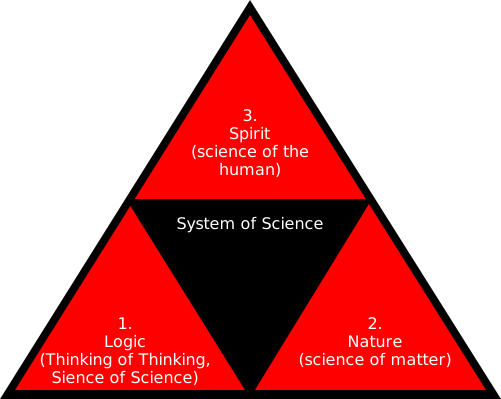
The disjunctive articulation of knowledge: The “other” of logic divides completely into two spheres: the logic of the world insofar as it does not proceed consciously as logic (Nature), and the logic of the world insofar as it does (Spirit). This is not an arbitrary division but a disjunctive one — tertium non datur.

The unity of both transitions:

Aspect To Nature To the Other
Status Object Subject
Perspective Has none of its own Has its own
Relation I know it I and the Other know together
Mode of truth Correspondence Consensus, recognition

Both are constitutive for thought — not added afterward, but conditions of its possibility. The twofold transition is therefore not a loss for logic but its completion: logic recognizes that it is not everything — and precisely through this it becomes concrete.

The Three Circles — Performative, Chronological, Systematic

Here the relationship of chicken and egg gets clarified. Three different starting points — and all three are true:

Circle Starting Point Movement Question
Performative Mind (our thinking) We begin with mind — we are thinking now How do we know?
Chronological Nature (historical) Nature existed before humanity (evolution, the Big Bang) How did it come to be?
Systematic Logic (methodical) Logic is the systematic ground of both How do we order it?

The tension between these perspectives is productive, not contradictory: performatively, we start from our life-practice, which is always more than pure logic. Systematically, however, logic — explicated as the foundation — demands its application to the totality of experience. And chronologically, temporality itself first appears within the philosophy of nature — only from there do we understand, looking back, that nature also existed temporally before mind. The three circles come together completely only at the end, in philosophy as part of absolute spirit.

Practical Methodology — What You Can Do Now

Dialectical Conflict Resolution: Contradictions are not malfunctions but the engine of development. Three steps: (1) Preserve — What is the legitimate core in each position? Even seemingly absurd opinions often contain a kernel of truth. (2) Overcome — Where does the problem lie? Usually in treating a relative aspect as absolute. (3) Raise to a higher level — Which principle integrates both sides? Example: A conflict between studying and free time. Preserve: concern for the future (parents) + the need for self-development (child). Overcome: a false alternative. Higher level: a study plan that makes both possible.

The Detective Principle: Truth lies in the systematic integration of all relevant aspects — just as in a detective novel, where all the clues must fit into a coherent overall picture. Four criteria: Completeness (are all perspectives taken into account?), Coherence (does everything fit together?), Correspondence (does it explain the recalcitrant experience?), Fruitfulness (does it open up new possibilities for insight?).

Oriented Pluralism: Truth is processual and open, but not arbitrary. The stance: Fidelity to principle (holding fast to methodological standards), openness in content (readiness to revise one’s convictions), willingness to learn (regarding everyone as a potential teacher), critical solidarity (a shared search for truth amid differing views).

The Philosophy of Nature and Spirit — Logic as Heuristic, Not as Derivation

Logic provides a heuristic order — not as derivation (Extreme A: logicism), but also not as mere irrelevant formalism (Extreme B: separation), but rather as heuristic: it shows where to look, how to organize, which confusions to avoid.

Philosophy of Nature — three levels arising from Objectivity (L14–18): Mechanism -> space, time, matter, gravitation (external relations). Chemism in the broad sense -> thermodynamics, electricity, crystal formation, chemical affinities (internal affinities). Teleology/Life -> organisms, self-preservation, reproduction (S³ processes). A correction to Hegel: Hegel denied that nature has any historicity (Encyclopedia §249). Modern science shows that nature does have a history — cosmic evolution, geological development, biological evolution. We correct Hegel with his own tools.

Philosophy of Spirit — three levels arising from Teleology:

Level Logical In Spirit Question
Subjective Spirit The purpose for itself From body through recognition to self-knowledge How does the natural being become a free subject?
Objective Spirit The world as means Right, Morality, Ethical Life (family, civil society, state) How does freedom organize itself socially?
Absolute Spirit Reflection on purposes Art (intuition), Religion (representation), Philosophy (thought) How does spirit come to know itself?

The Threefold Necessity of Transition

Logic cannot remain with itself because: (1) Performatively: It presupposes the you — every argument addresses someone, recognition is not addition but condition. (2) Systematically: It recognizes its contentual limitedness — the concrete world (nature, history, society) is missing. (3) Self-critically: It knows its limits — self-application shows that logic points beyond itself without being able to generate this “beyond” from itself.

The Fundamental Openness of the Process — The Sublation of Hegel Himself

The search for truth is an open, unfinishable process. One does not end up at “Hegelian philosophy,” but rather continues applying the method — including to Hegel himself. The dialectical method must be applied to its own originator: his insights must be preserved (the performative method, the development of categories, the spiral structure), his time-bound limits must be overcome (the missing historicity of nature, the monological transition, the underestimation of intersubjectivity), and his thoughts must be raised to a higher level (the explicit derivation of ethics, the double transition, the system/enactment dual perspective).

Understood this way, dialectics is no dogmatic formula, but an open guide for systematic truth-finding. Logic is the eye, not the world. It sharpens the gaze, but it does not replace looking. The transition to the philosophy of reality — to nature, to the Other, to history — is no loss, but exactly what logic was there for: not to remain within itself, but to become effective in the world.


Glossary of Central Concepts

The following terms are not academic definitions but instructions for movement in thinking. A fuller version with more than 250 entries — arranged alphabetically and systematically, with citations to Hegel’s text and notes on the state of scholarship — can be found in [[hegels-logik]] (optional).

In itself / For itself / In and for itself: In itself — the disposition, the potential (as the seed contains the tree), still unfolded. For itself — reflection and demarcation, the “I” that distinguishes itself from the Other. In and for itself — accomplished actuality: the potential is realized and knows itself as such.

Sublation: The threefold miracle-word: (1) negating (ending), (2) preserving (retaining), (3) elevating (ennobling). Nothing true is lost. Technically: tollere (to lift away, to abolish), conservare (to preserve), elevare (to raise to a higher level).

Concept: Not “the meaning of a word,” but the genetic structure of the matter itself. The “I” of the thing. Structured as U-P-I (Universal–Particular–Individual). Hegel’s concept of the concept is itself an instance of the concept: a structure that unfolds out of itself.

Dialectic: Not merely “dialogue,” but the self-movement of content through contradictions. The engine that drives every finite thing beyond itself. Three moments: the understanding (fixed determination), the dialectical (dissolution through contradiction), the speculative (restoration on a higher level).

Existence: Unlike mere being-there (the logic of being), existence is what has “emerged from a ground” — that is, grounded being. A thing exists because it has reasons.

Being-for-itself: The highest form of qualitative self-relation. The something relates only to itself, as pure “one.” The negation of the negation — the finite that has found itself again in the other.

Idea: The unity of concept and reality. When what ought to be (the concept) and what is (objectivity) coincide. The highest term in the Logic — not a distant ideal, but the true realizing itself.

Compossibility (fitting-together-ness): An extension of the theory of possibility (Leibniz): not merely “Is A possible?” but “Can A and B be possible together?” Ethically decisive: the demand for universalizability is at its core a test of compossibility.

Moment: Not a point in time, but a non-self-sufficient component of a whole. Like the hand on the body: real, but only viable as part of the whole. Conceptually decisive: whoever removes one moment changes all the others.

Reflection: The form of movement proper to the logic of essence. Three forms: positing reflection (self-relation, tautology), external reflection (relation to something other, arbitrariness), determining reflection (the unity of both — insight into necessity). The master key to Hegel’s architecture.

Shining into one another: The form of movement proper to the logic of essence — reciprocal constitution, in which both sides are preserved. Identity and difference “shine” into one another as in a mirror. Unlike passing-over (the logic of being: A vanishes, becomes B), here both sides remain.

Substance: Not a dead substrate, but a power that posits and retracts its accidents. Spinoza’s single substance is Hegel’s starting point, but: substance must be essentially active — it must become subject.

Immediacy / Mediation: Immediate — simply “there,” without context. Mediated — brought about through reasons, history, or relations. The Logic is the path from immediacy to total mediation — and the discovery that immediacy itself was always already mediated.

Passing-over: The form of movement proper to the logic of being — A vanishes, becomes B. One-dimensional, unstable. The “flattest” of the three forms of movement.

Truth: For Hegel, not the agreement of a statement with a fact (“correctness”), but the agreement of an object with its own concept. A “true friend” is one who corresponds to the concept of friendship. “True” is a normative predicate, not a descriptive one.

Reciprocity (Wechselwirkung): The highest form of the logic of essence. A and B constitute each other reciprocally — neither comes first; both are only in mutual determination. “The truth of necessity is freedom” — reciprocal determination is self-determination.

Spiral staircase: An image for the spiral-shaped structure of the Logic: each turn returns to the starting point, but on a higher level. Logic of being -> logic of essence -> logic of the concept, and within each part the same movement. The spiral is no ornament but the basic structure of comprehension: first enact (implicitly), then reflect, then comprehend (explicitly).


Suggested Reading

The following texts are the most important sources and interlocutors for this book:

G.W.F. Hegel: Encyclopedia of the Philosophical Sciences, 3rd edition 1830 (main text). Science of Logic (1816/1832) for the more detailed logic of being and essence.

Johannes Heinrichs: Reflexionstheoretische Semiotik [Reflection-Theoretical Semiotics] (2 vols.) and other works. Decisive for the distinction between implicit and explicit reflection, the four stages of reflection, and the system/enactment double perspective.

Pirmin Stekeler-Weithofer: Hegels Analytische Philosophie [Hegel’s Analytic Philosophy] and further contributions. A linguistic-analytic reading that understands Hegel’s categories as the grammar of social practice. The sortal presupposition of counting, the critique of the point-set conception, chemism as the logic of personal roles.

Georg Werckmeister: Dissertation on Hegel’s syllogistics. Important for understanding the threefold permutation.

Ulrich Ruschig: Hegels Logik und die Chemie [Hegel’s Logic and Chemistry] (1997). Empirical demonstration that Hegel’s chemical material is constitutive, not merely illustrative.


Afterword: What This Presentation Accomplishes and What It Does Not

This presentation condenses a commentary of more than one and a half million characters to a tenth of that length. What should be preserved in doing so is the movement of the subject matter: the sequence of categories, the necessity of their transitions, the three forms of movement and their order.

What is necessarily lost is the fullness of detail — the references to sources, the engagement with the scholarly literature, the experiments by which the transitions can be tested, and the glossary. Anyone who wants to know more precisely, at a given point, what a claim rests on will find it in [[hegels-logik]] (optional); the chapter numbers correspond.

What this logic accomplishes: It shows that the categories of thought do not follow one another arbitrarily. Each presupposes the one before it, and where one is missing, the sequence breaks. This is less than a proof of completeness and more than a recommendation of order.

What it does not accomplish: It supplies no content. Anyone who wants to know what nature is like, or what ought to be done in a given situation, will find here the forms of questioning, not the answers. The warning that runs through the doctrine of objectivity also applies to the use of this presentation: whoever has mastered the categories but does not know the object has gained nothing.

What remains open: Whether the sequence is complete cannot be proven — the proof consists in the fact that no gap has been found. Formal derivability of the transitions is not the standard here; what is demanded and claimed is the best possible ordering of conceptual thought, and that can be tested: whoever finds a step that does not hold has found something. And whether the logic captures the relation of thought and being, or remains merely an order of thought, was addressed in the doctrine of objectivity and was not conclusively decided there.

The absolute idea is not an end. It is the point at which logic proves insufficient for what lies outside it — and in precisely this, it has fulfilled its task.


Further reading

The sources and interlocutors of this commentary are listed in the annotated bibliography on the Logic. (German only for now.)