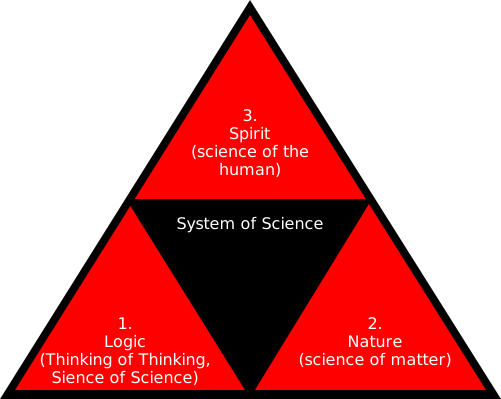
Interpretive Sociology - Meaning, Form, Rationalization (1890-1920)
This text is a preview of History of the Reception of Hegel, volume I, to be published in 2026 by Reflexivity Press.
Interpretive sociology (verstehende Soziologie) arises as a reaction against positivism. Auguste Comte had conceived sociology as a “physics of the social” – laws of coexistence, analogous to natural laws. Interpretive sociology insists: the social is not nature. Human beings do not act according to causal laws, but according to meaning. Their actions have significance, intention, purpose. This dimension of meaning cannot be causally explained, only understood (verstanden).
This is Hegelian at its core: objective spirit is a structure of meaning. Institutions (law, morality, the state) are not mere factual arrangements, but normative orders. They mean something, are valid for something, claim legitimacy. This dimension of meaning cannot be analyzed by natural science – it requires hermeneutic understanding, conceptual reconstruction, reflective penetration.
Two thinkers are central: Georg Simmel and Max Weber. Both attempt to found a science of meaning – but with very different means and consequences.
Georg Simmel - Forms of the Social
Georg Simmel (1858-1918) is the most original and least recognized German sociologist. As a Jew, as an outsider, as an essayist rather than a systematic thinker, he remained without a full professorship for his whole life (only in 1914 did he get one, in Strasbourg, too late for major influence). His sociology is not a textbook, but a kaleidoscope of brilliant miniatures.[1]
The basic thesis: The social does not consist of individuals, but of interactions (Wechselwirkungen). Society is not the sum of human beings, but a network of relations. These relations have forms – structures that repeat themselves, independently of concrete content. Domination, subordination, conflict, cooperation, exchange – these are social forms that appear in the most various contexts.[2]
Example: Conflict. Simmel writes an essay “Conflict” (Der Streit, 1908), which shows: conflict is not a disturbance of society, but one of its forms. Conflict connects – it creates intense relation between antagonists, forces mutual attention, generates solidarity within the conflicting parties. Without conflict there would be no dynamic, no change, no vitality. A harmonious society would be dead.[3]
The method is phenomenological: Simmel describes social forms as they show themselves. He does not seek causal laws (why does conflict arise?), but structures (what happens when conflict arises?). These structures are not timelessly logical (as in Hegel), but typical – they repeat themselves under certain conditions, but allow for variation.[4]
Philosophy of Money (1900) is Simmel’s major work. It is not economics, but philosophy of culture: an analysis of how money structures modern society. Money is not merely a medium of exchange, but a symbolic form – it objectifies value, abstracts from qualities, makes everything comparable.[5]
The point is Hegelian: money is alienation. It mediates between people, but this mediation becomes independent. Money, originally a means to an end (I exchange in order to buy bread), becomes an end in itself (I want money, regardless of what for). The means become independent, the ends fade. The merchant no longer knows the goods, only the prices. The worker no longer knows the product, only the wage. Life freezes into reification.[6]
But – and this is Simmel’s difference from Hegel – this alienation is tragic, not to be sublated. Hegel had believed that alienation could be overcome in ethical life – in institutions that reconcile subjective freedom and objective order. Simmel is skeptical. The objectifications of spirit (money, technology, bureaucracy) necessarily freeze into rigidity. Life – flowing, spontaneous, creative – objectifies itself in forms – fixed, rigid, dead. This dialectic cannot be brought to a close. Every new form freezes; every new life must assert itself against old forms.[7]
The problem of 1914: Simmel welcomes the First World War as Germany’s “great hour.” His essays of 1914-1916 speak of “renewal,” “deepening,” “overcoming materialism.” The war appears as an opportunity to break open the frozen order of peace, to renew authentic communal experience. Simmel is no militarist, no nationalist – but his contempt for bourgeois society, his longing for “genuine life,” his rejection of the “mechanical” make him susceptible to war-euphoria.[8]
This attitude is typical of German intellectuals in 1914: modern civilization is regarded as soulless, materialistic, decadent. The war promises renewal – community instead of society, heroism instead of the shopkeeper’s mentality, German inwardness instead of Western superficiality. Simmel shares these affects, but partially overcomes them: his later texts (1917-1918) become more disillusioned, more critical. He dies in 1918, shortly before the war’s end, of liver cancer.[9]
The systematic achievement: Simmel shows that social forms have their own reality – they are neither merely individual consciousness (psychologism) nor merely external constraints (positivism). They are objective spirit, but without Hegel’s teleological overload. Simmel’s sociology is a phenomenology of the social – it describes structures without deducing them. This makes it more amenable to empirical work than Hegel’s speculative construction, but also less systematic. Simmel loses the unity that Hegel sought – the principle that grasps all social forms as moments of one process.[10]
Max Weber - Rationalization and Disenchantment
Max Weber (1864-1920) is the most influential classic figure of sociology. His works – The Protestant Ethic and the Spirit of Capitalism (1904/05), Economy and Society (1922, posthumous) – shape the social sciences to this day. Weber came to sociology from law and national economics, and always remained a border-crosser between disciplines.[11]
The basic thesis: The central phenomenon of modernity is rationalization. Western civilization is distinguished by the fact that it increasingly rationalizes all areas of life – the economy (calculation, bookkeeping), politics (bureaucracy, law), science (experiment, mathematics), even religion (Protestant ethic as a rational conduct of life). This rationalization is the disenchantment of the world – the loss of magical, mythical, religious interpretation of the world in favor of an objective, calculable, instrumental orientation.[12]
The parallel to Hegel is striking, although Weber rarely cites Hegel. Hegel’s world history is progress in the consciousness of freedom – from immediate unity (the Orient) through division (antiquity) to comprehended reconciliation (modernity). Weber’s thesis of rationalization is a secularized philosophy of history: modernity as the culmination of rationalization, but without reconciliation. Disenchantment is ambivalent – a gain in calculability, a loss of meaning.[13]
Weber came to Hegel indirectly, via neo-Kantianism (Heinrich Rickert). Rickert had distinguished: the natural sciences seek laws (the general), the cultural sciences understand meaning (the individual). Weber takes over this distinction, but transforms it: sociology is an interpretive science, which seeks typical contexts of meaning. What interests it is not individual motivations, but ideal-typical orientations of action.[14]
The four types of action (instrumentally rational, value-rational, affectual, traditional) are such ideal types. No human being acts purely instrumentally-rationally – but the concept “instrumentally rational” helps to analyze real action. The entrepreneur who maximizes profit acts approximately instrumentally-rationally. The monk who lives ascetically acts approximately value-rationally. Both are extreme cases, but they illuminate reality.[15]
The Protestant Ethic and the Spirit of Capitalism (1904/05) exemplifies Weber’s method. The thesis: modern capitalism does not arise from greed (which has always existed), but from Protestant asceticism. The Calvinist lives methodically, disciplined, works tirelessly – not in order to enjoy, but to assure himself of his election. This inner-worldly asceticism creates the mentality of rational capitalism: calculation, reinvestment, self-discipline.[16]
The point is dialectical (although Weber avoids the word): religious motivation (certainty of election) creates a secular practice (methodical labor) that ultimately makes religion itself superfluous. Asceticism becomes routine, faith becomes habit, meaning becomes a means. In the end stands the “iron cage” (literally: “steel-hard housing”) – a rationalized world without transcendent meaning, in which human beings function, but no longer live.[17]
The concepts:
- Instrumental rationality (Zweckrationalität): action according to a means-end calculus (technical-instrumental)
- Value rationality (Wertrationalität): action according to unconditional values (ethical-principled)
- Charisma: the extraordinary quality of a person that generates obedience
- Bureaucracy: rational domination through rules, offices, hierarchies
Weber shows: modernity rationalizes, but this rationalization is one-dimensional. Instrumental rationality displaces value rationality. The instrumental displaces the substantive. The question “How do I achieve my goal?” replaces the question “What is my goal worth?” This is Weber’s version of alienation – but without Hegel’s hope for sublation.[18]
Weber 1914: War Enthusiasm and Disillusionment
Max Weber welcomes the outbreak of war in 1914 enthusiastically. In letters he writes: “This war, for all its horror, is great and wonderful; it is worth experiencing.” He volunteers for service (at age 50!), becomes director of a reserve military hospital in Heidelberg. His motives are complex: nationalism, hope for German “renewal,” contempt for Western civilization as a “shopkeeper’s mentality.”[19]
Weber shares this attitude with many German professors. The “Ideas of 1914” against the “Ideas of 1789”: German culture (depth, inwardness, community) against Western civilization (superficiality, materialism, society). Thomas Mann formulates this systematically later, in Reflections of a Nonpolitical Man (1918) – Weber thinks similarly, but does not spell it out.[20]
But Weber becomes disillusioned faster than others. From 1916 he criticizes German warfare; from 1917 he calls for a negotiated peace; from 1918 he accepts defeat and commits himself to the democratization of Germany. Weber does not become a democrat out of conviction, but out of insight: Germany needs parliamentary control, or chaos threatens.[21]
The systematic lesson: Weber’s initial war enthusiasm shows the danger of cultural criticism. Contempt for the “mechanical,” the “Western,” the “superficial” can flip into a longing for “renewal” through violence. Weber overcomes this – through sober analysis, not through enthusiasm. His sociology after 1918 is disillusioned, but not cynical. It accepts modernity with its contradictions, instead of fleeing into anti-modern romanticism.[22]
The Limit of Empiricization: The Loss of Systematic Unity
Both Simmel and Weber attempt to grasp Hegel’s objective spirit empirically. Both recognize: the social has its own reality – it is neither mere nature nor mere consciousness, but a structure of meaning, objectified in institutions, habits, forms. Both develop methods for analyzing these structures of meaning – Simmel phenomenologically (description of typical forms), Weber ideal-typically (construction of rational models).[23]
The problem: they lose the systematic unity. Hegel had attempted to show: law, morality, ethical life, the state are moments of a unified process – the realization of freedom. Each moment is necessary, each refers to the others, all together form the totality of objective spirit. This unity is lost in Simmel and Weber.
Simmel collects brilliant individual analyses – conflict, fashion, poverty, secrecy, the stranger. But how do they hang together? What is the principle that grasps all social forms as variations of one basic theme? Simmel gives no answer. His sociology is a kaleidoscope, not a system.[24]
Weber constructs ideal types – forms of domination (charismatic, traditional, legal-rational), economic modes (subsistence, market, plan), types of religion (salvation religions, ethical religions, cultural religions). But how do they hang together? Weber explicitly rejects the philosophy of history – there is no logic of history, no necessary development, no teleology. Rationalization is a factual process, not a conceptual necessity. This makes Weber more empirically cautious than Hegel, but also systematically poorer.[25]
The consequence: the individual sciences arise – sociology, ethnology, cultural studies. They investigate objective spirit empirically, without Hegel’s metaphysical premises. But they lose the philosophical perspective: the question of unity, of the meaning of the whole, of the legitimation of the existing order. Science becomes positive – it describes what is, but no longer asks whether it ought to be.[26]
The reaction: Phenomenology (Husserl, Heidegger) attempts to go back behind this empiricization – to the intuition of essences (Wesensschau), to an a priori analysis of structure. Critical Theory (Horkheimer, Adorno) criticizes positivism – demanding reflection on the social conditions of science. Both are attempts to rescue Hegel’s systematics without taking over his speculative metaphysics. (See Chapters 24 and 26)[27]
The Systematic Lesson: Objectivity Without Metaphysics?
Can objective spirit be empirically investigated? The answer of folk psychology, anthropology, and sociology is: yes, but – yes, social phenomena are investigable, but not as mere nature. They require understanding, not only explanation. They have meaning, not only causality. They claim validity, not only facticity.[28]
The problem: how does one distinguish facticity and validity scientifically? Folk psychology fails on psychologism – it reduces norms to psychic states. Anthropology oscillates between description (Plessner) and affirmation (Gehlen) – does it merely describe what is, or does it legitimize it? Sociology (Simmel, Weber) renounces normativity – it analyzes rationalization, but does not ask whether it is right.[29]
Hegel’s claim was greater: objective spirit is not merely factual, but normative. Institutions must justify themselves before reason. Not every existing order is rational – only the one that realizes freedom. This normative dimension cannot be empirically proven – it requires philosophical reflection.[30]
The human sciences of the nineteenth century attempt to preserve Hegel’s insights without his metaphysics. This succeeds partially – they show that social phenomena have their own reality, that they are not reducible to nature or consciousness. But they lose Hegel’s critical potential – the question of whether the existing order is rational. This question remains philosophical – it cannot be delegated to the individual sciences.[31]
The task of a contemporary systematics: to integrate the empirical insights of the human sciences without giving up their normative dimension. To show that social structures are investigable (against Hegel), but not value-neutral (against positivism). Reflection on the conditions of the possibility of social order must remain transcendental (Kantian), but the concrete contents must be filled empirically (Hegelian). This is the synthesis sought in the twentieth century – by Cassirer, Habermas, Brandom.[32]
On the biography: Klaus Christian Köhnke: Der junge Simmel in Theoriebeziehungen und sozialen Bewegungen, Frankfurt/M.: Suhrkamp, 1996. Simmel received a professorship only in 1914 (at age 56) – in Strasbourg, shortly before his death in 1918. ↩︎
Georg Simmel: “Das Problem der Soziologie” (1908), in: Soziologie. Untersuchungen über die Formen der Vergesellschaftung, Berlin: Duncker & Humblot, 1908, pp. 1-31. The foundation of “formal sociology.” ↩︎
Georg Simmel: “Der Streit” (1908), in: Soziologie, pp. 186-255. The thesis: “Conflict is […] one of the most vital forms of interaction” (p. 186). ↩︎
On the method, see: Otthein Rammstedt (ed.): Simmel und die frühen Soziologen, Frankfurt/M.: Suhrkamp, 1988. ↩︎
Georg Simmel: Philosophie des Geldes, Leipzig: Duncker & Humblot, 1900. New edition: Gesamtausgabe, vol. 6, Frankfurt/M.: Suhrkamp, 1989. ↩︎
Simmel: Philosophie des Geldes, pp. 510-524: “The Style of Life.” The objectifications of spirit become independent, set against life. ↩︎
This tragedy is explicitly formulated by Simmel in: “Der Begriff und die Tragödie der Kultur” (1911), in: Philosophische Kultur, Leipzig: Kröner, 1911, pp. 245-277. ↩︎
Georg Simmel: “Deutschlands innere Wandlung” (1914), in: Gesamtausgabe, vol. 16, pp. 11-23. Simmel sees in the war a “deepening” of the German spirit. ↩︎
Simmel dies on September 26, 1918, in Strasbourg, of liver cancer. His last texts (1917-1918) are more pessimistic, more disillusioned. Literary remains: Gesamtausgabe, vol. 24, Frankfurt/M.: Suhrkamp, 2015. ↩︎
On Simmel’s systematic significance, see: Heinz-Jürgen Dahme / Otthein Rammstedt (eds.): Georg Simmel und die Moderne, Frankfurt/M.: Suhrkamp, 1984. ↩︎
On the biography: Joachim Radkau: Max Weber. Die Leidenschaft des Denkens, Munich: Hanser, 2005. A standard work of over 1,000 pages. ↩︎
Max Weber: “The Protestant Ethic and the Spirit of Capitalism” (1904/05), in: Gesammelte Aufsätze zur Religionssoziologie, vol. 1, Tübingen: Mohr, 1920, pp. 17-206. The thesis on rationalization is systematically developed in: “Vorbemerkung” (1920), ibid., pp. 1-16. ↩︎
On Weber’s implicit reception of Hegel, see: Wilhelm Hennis: Max Webers Fragestellung, Tübingen: Mohr, 1987, pp. 133-167. ↩︎
Heinrich Rickert: Die Grenzen der naturwissenschaftlichen Begriffsbildung, Tübingen: Mohr, 1896. Weber studied under Rickert, adopted the distinction between natural and cultural sciences, but transformed it sociologically. ↩︎
Max Weber: Economy and Society (1922), Tübingen: Mohr, chap. 1, § 2: “Sociological Basic Categories of Economic Action.” The four types of action: instrumentally rational, value-rational, affectual, traditional. ↩︎
Weber: “The Protestant Ethic,” esp. part II: “The Practical Ethics of the Ascetic Branches of Protestantism,” pp. 84-163. ↩︎
Weber: “The Protestant Ethic,” pp. 203-204: “the iron cage of bondage […] in which, perhaps, the last ton of fossil fuel will one day have burnt away.” ↩︎
On the critique of Weber’s concept of rationality, see: Jürgen Habermas: The Theory of Communicative Action, vol. 1, Frankfurt/M.: Suhrkamp, 1981, pp. 332-366: Weber reduces reason to instrumental rationality. ↩︎
Quoted after Wolfgang J. Mommsen: Max Weber und die deutsche Politik 1890-1920, Tübingen: Mohr, 1959, p. 204. ↩︎
Thomas Mann: Reflections of a Nonpolitical Man, Berlin: S. Fischer, 1918. A systematic elaboration of the opposition “German culture vs. Western civilization.” ↩︎
Max Weber: “Parlament und Regierung im neugeordneten Deutschland” (1918), in: Gesammelte Politische Schriften, Tübingen: Mohr, 1958, pp. 294-431. Weber demands parliamentarization for pragmatic, not principled, reasons. ↩︎
On the ambivalence of Weber’s understanding of modernity, see: Friedrich H. Tenbruck: “Das Werk Max Webers,” in: Kölner Zeitschrift für Soziologie und Sozialpsychologie 27 (1975), pp. 663-702. ↩︎
On the systematic problem of “interpretive sociology,” see: Alfred Schütz: Der sinnhafte Aufbau der sozialen Welt, Vienna: Springer, 1932. Schütz phenomenologically shows the limits of Weber. ↩︎
Cf. the critique in Georg Lukács: “Zur Soziologie des modernen Dramas” (1914), in: Schriften zur Literatursoziologie, Neuwied: Luchterhand, 1961, pp. 261-295: Simmel lacks dialectical totality. ↩︎
Weber explicitly rejects the philosophy of history in: “‘Objectivity’ in Social Science and Social Policy” (1904), in: Gesammelte Aufsätze zur Wissenschaftslehre, Tübingen: Mohr, 1922, pp. 146-214. ↩︎
This development is criticized by: Herbert Marcuse: “Der Kampf gegen den Liberalismus in der totalitären Staatsauffassung” (1934), in: Kultur und Gesellschaft, vol. 1, Frankfurt/M.: Suhrkamp, 1965, pp. 17-55. ↩︎
Foundational: Edmund Husserl: The Crisis of European Sciences and Transcendental Phenomenology (1936), The Hague: Nijhoff, 1954. Husserl criticizes positivism as a “loss of meaning.” ↩︎
This position is later systematically developed by: Charles Taylor: The Explanation of Behaviour, London: Routledge, 1964; idem: “Interpretation and the Sciences of Man” (1971), in: Philosophy and the Human Sciences, Cambridge: CUP, 1985, pp. 15-57. ↩︎
On the problem of value judgments, see: Max Weber: “The Meaning of ‘Ethical Neutrality’ in Sociology and Economics” (1917), in: Gesammelte Aufsätze zur Wissenschaftslehre, pp. 489-540. ↩︎
Hegel: Elements of the Philosophy of Right (1821), preface: “What is rational is actual; and what is actual is rational.” But: not everything that exists is “actual” in this sense – only the rational is. ↩︎
This critique is formulated by the Frankfurt School: Max Horkheimer: “Traditional and Critical Theory” (1937), in: Gesammelte Schriften, vol. 4, Frankfurt/M.: Fischer, 1988, pp. 162-216. ↩︎
Systematic syntheses are attempted by: Ernst Cassirer: The Philosophy of Symbolic Forms, 3 vols., Berlin: Bruno Cassirer, 1923-1929; Jürgen Habermas: The Theory of Communicative Action, 2 vols., Frankfurt/M.: Suhrkamp, 1981; Robert Brandom: Making It Explicit, Cambridge/MA: Harvard UP, 1994. ↩︎