Alexandre Koyré — The Forgotten Forerunner (1929-1964)
This text is a preview of History of the Reception of Hegel, volume II, to be published in 2026 by Reflexivity Press.
Framing: The Movement of the Whole
Alexandre Koyré (1892–1964) is the great exception in the French reception of Hegel — and at the same time its secret foundation. He was not a spectacular thinker like Kojève, not a brilliant stylist like Sartre, not an institutional mediator like Hyppolite. But he was the first to bring Hegel seriously to France — already in the late 1920s, thus before the “explosion” of the 1930s and 1940s.
The paradox: Koyré prepared the French Hegel renaissance — but was overshadowed by it. His cousin Alexandre Kojève (actually Kozhevnikov) became the star of Hegel interpretation, while Koyré himself increasingly turned to the history of science. This shift was not accidental — it shows something essential about the character of the French reception of Hegel.
The temporal development is illuminating: in the 1920s and early 1930s Koyré published foundational studies on Hegel — on the history of philosophy in Hegel (1930), on Hegel in Jena (1934/35).[1] But in the late 1930s, just as Kojève’s lectures conquered the philosophical scene, Koyré turned to the history of science: Galileo (1939), Newton (1950s), the astronomical revolution.[2] He spent his late years between Paris and Princeton — as mediator between the French and Anglo-American traditions.
This development raises a question: why did Koyré turn away from Hegel just as Hegel became popular in France? The answer shows the limits of the existentialist appropriation of Hegel.
Intellectual-Historical Placement: Who Is Koyré? What Is He Reacting To?
Alexandre Koyré was born in 1892 in Taganrog (Russia) — into a wealthy Jewish merchant family. The Russian Revolution of 1905 politicized him early. In 1908 he went to Göttingen to study philosophy and mathematics — with Husserl, with Hilbert. This combination — phenomenology and mathematics — shaped his thinking fundamentally.[3]
In 1912 he came to Paris, where he continued his studies. The First World War interrupted his academic career — he fought in the French Foreign Legion, was wounded, received the Croix de Guerre. After the war he returned to philosophy, receiving his doctorate in 1929 on “the proofs of God’s existence in Anselm and Descartes.”[4]
Koyré belonged to the Russian emigration in Paris — an intellectual milieu of extraordinary quality. His cousin Alexandre Kozhevnikov (later Kojève) came to Paris in 1926. They stayed in contact, but their intellectual paths diverged fundamentally. Koyré was a scholar — meticulous, philologically precise, institutionally anchored. Kojève was a visionary — speculative, provocative, outside academic structures.
What is Koyré reacting to with his work on Hegel? To two challenges:
First: French ignorance of German philosophy. French philosophy was Cartesian, positivist, spiritualist — but it scarcely knew Kant, not at all Fichte, Hegel only as caricature. Koyré wanted to close this gap — not through popularizing introductions, but through solid historical work.
Second: the reduction of Hegel to “system philosophy.” The usual presentation depicted Hegel as a thinker of a closed system — rigid, dogmatic, outdated. Koyré shows: Hegel’s thought developed, it went through crises, it wrestled with problems. The young Hegel (Jena 1801–1807) was different from the Berlin Hegel. This historical differentiation was important against any dogmatization.
The Steelman Position: Koyré’s Historical-Philological Interpretation of Hegel
The History of Philosophy in Hegel (1930) — Historicization of the Absolute
Koyré’s dissertation on “The History of Philosophy in Hegel” (1930) was the first systematic investigation of this dimension in France.[5] It shows something the existentialist reception will ignore: Hegel’s philosophy is essentially historical — but not in the sense of historicism, but as a systematic integration of history into the system.
The central thesis: for Hegel, the history of philosophy is not an external sequence of opinions, but “progressive development of truth.”[6] Every philosophical position is a moment in the process of finding truth. Earlier positions are not simply “false” — they are one-sided, abstract, incomplete. Later philosophy sublates them — preserves their truth, negates their one-sidedness, integrates them at a higher level.
This conception is revolutionary. It overcomes two extremes:
- Relativism: all philosophies are equally valid, none more true than another. That leads to arbitrary pluralism without criterion.
- Dogmatism: only one philosophy is true, all others are false. That leads to sectarianism and intolerance.
Hegel shows a third way: there is truth — but it develops historically. There is progress — but it does not proceed linearly, but dialectically. Earlier positions are not eliminated, but sublated.
The consequence for the interpretation of Hegel: Koyré shows: one cannot understand Hegel without understanding the history to which he is reacting. Hegel’s logic is not timeless systematics, but the result of engagement with Kant, Fichte, Schelling. His philosophy of right is an answer to the French Revolution. His philosophy of religion reacts to the Enlightenment.
This historical embedding is almost entirely lacking in Kojève, Sartre, Merleau-Ponty. They read Hegel “systematically” — as a timeless thinker of structures. Koyré shows: these structures became historical. That does not make them relative — but it makes them comprehensible.
Hegel in Jena (1934/35) — The Development of the System
Koyré’s essays on Hegel’s Jena period are pioneering works.[7] They show: the Berlin Hegel (1818–1831) — authoritarian, conservative, close to the state — was not always this way. The young Hegel (1801–1807) was revolutionary, critical, searching.
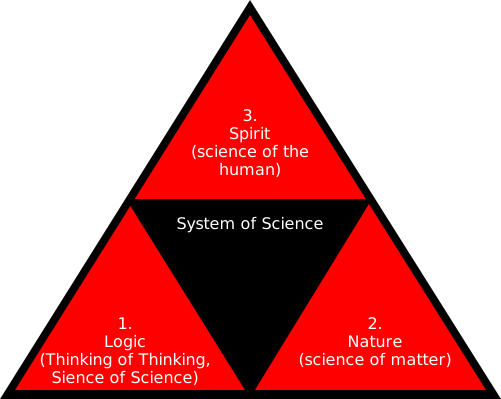
The Jena system attempts: between 1801 and 1807 Hegel wrote several system drafts, published only in the 20th century.[8] Koyré belonged to the first to systematically evaluate these texts. They show: Hegel wrestled with the question of how the various parts — logic, nature, spirit — hang together. The early drafts are structured differently than the later system.
This discovery is philosophically important. It shows: the system did not fall from heaven. It is the result of long work, many revisions, intensive engagement with contemporaries (Schelling above all). “Absolute idealism” is not starting point, but result.
The difference from the existentialist reception: Kojève, Sartre, Hyppolite concentrate on the Phenomenology of Spirit (1807) — Hegel’s first major work. They treat it as introduction to a system that is then known. Koyré shows: in 1807 the system was not yet finished. The Phenomenology was search, not result. This genetic perspective relativizes the systematic claims.
The Turn to the History of Science (from 1939) — Abandonment or Deepening?
From the late 1930s Koyré’s focus shifts dramatically. He publishes scarcely anything more on Hegel, instead monumental studies on the history of science: Études galiléennes (1939), From the Closed World to the Infinite Universe (1957), La révolution astronomique (1961).[9]
The usual interpretation: Koyré gave up Hegel in favor of the history of science. He recognized that speculative philosophy is superseded by empirical science.
The deeper truth: Koyré applies Hegel’s method to the history of science — even if he no longer cites Hegel. His studies show: scientific revolutions are not only accumulation of data, but paradigm shifts, transformations of basic concepts, dialectical upheavals.
The example of Galileo: Aristotelian physics was not refuted through new experiments, but through a new way of thinking. Galileo did not ask “what moves?” but “how does it move?” He mathematized nature — and thereby changed what “nature” means. That is not a “refutation” of Aristotle — it is a sublation: Aristotle’s insights are preserved (motion is real), negated (motion is not qualitative, but quantitative), and elevated to a higher level (mathematical natural science).[10]
The implicit critique of Hegel: Koyré also shows the limits of Hegel’s philosophy of nature. Hegel tried to derive natural laws from concepts — that failed. Nature follows mathematical laws that must be found empirically. Hegel’s speculative physics is outdated.
But: the dialectical method is not outdated. It is applicable to the history of science. It shows how paradigms develop, how concepts transform, how revolutions are not ruptures, but sublations. This application is subtler than Hegel’s own philosophy of nature — precisely because it is less speculative, more empirical.
Sublation I: What Is True? (Preserving)
Koyré’s work contains essential insights that were lost in the existentialist reception of Hegel:
First: The Historicity of the System Koyré showed that Hegel’s system is not timeless truth, but historical product. It arose in particular contexts, as an answer to particular problems, in engagement with particular opponents. This historicization is not relativization — it is concretization.
This insight is methodologically important. One cannot interpret Hegel “atemporally” — one must understand the genesis of the system. The categories of logic are not a priori forms, but results of long philosophical development. This genetic perspective is entirely lacking in the existentialists.
Second: Development as Sublation Koyré’s studies on the history of science show: development is not linear accumulation, but also not arbitrary sequence. It is dialectical sublation — the earlier is preserved and transformed at once. Newton sublates Galileo, Einstein sublates Newton — but each stage integrates the previous one, instead of eliminating it.
This insight corrects a naive belief in progress (everything gets better) and a postmodern relativism (everything is of equal value). Truth lies in the dialectical movement: there is progress, but it takes place through crises, ruptures, transformations.
Third: The Necessity of Empiricism Koyré shows through his own work: speculative philosophy alone does not suffice. It must prove itself against empirical reality. Hegel’s philosophy of nature failed because it ignored empirical research. But the dialectical method is worth preserving — if it is combined with empirical research.
This insight is current. A contemporary reception of Hegel cannot remain speculative — it must be empirically informed. Logic must prove itself against cognitive science, philosophy of right against sociology, philosophy of history against historiography.
Fourth: The Mediating Function Koyré worked between traditions — Russian, German, French, American. He translated not only texts, but ways of thinking. This mediating function is philosophically productive. It shows: there is not “the” interpretation of Hegel. German, Russian, French readings each have different emphases — and all are partially justified.
This pluralistic insight is important against any dogmatism. There is not “the true Hegel” — there are productive appropriations from different perspectives. The task is not to find the “correct” one, but to integrate them dialectically.
Sublation II: The Internal Contradictions (Negating)
But Koyré’s position too has limits that follow from its own design:
First Contradiction: The Flight from Systematics Koyré turns away from Hegel just as Hegel becomes popular in France. Why? A possible interpretation: he saw that the existentialist appropriation simplified Hegel, vulgarized him, instrumentalized him for political purposes. Serious historical-philological work was drowned out by brilliant but superficial interpretations.
The problem: by withdrawing into the history of science, Koyré leaves the field to the simplifiers. His expertise would have been necessary to correct the existentialist reception. His absence leaves a gap.
In Hegel’s terminology: Koyré falls into “abstract negation.” He negates the existentialist reception (correctly) — but he develops no alternative (incorrectly). Instead of showing how Hegel could be read better, he withdraws. That is not overcoming, but avoidance.
Second Contradiction: The Apolitical Stance Koyré’s works are academic, learned, politically neutral. He analyzes philosophical systems, scientific revolutions, conceptual transformations — but he does not take a position on the burning questions of his time. The 1930s and 1940s — fascism, war, the Holocaust — do not appear in his texts.
That is understandable: Koyré was an emigrant, he had fought in the First World War, he had experienced persecution. Perhaps he wanted to preserve a space in which philosophy could be apolitical. But this neutrality was itself a political gesture — the gesture of academic purity that holds itself apart from the struggles.
The consequence: Koyré’s interpretation of Hegel remained historical, not normative. He showed how Hegel thought — but not what follows from Hegel for the present. The question of justice, of political order, of the role of philosophy after Auschwitz — all this remains outside.
In Hegel’s terminology: Koyré remains at the level of the “history of philosophy,” but does not reach the level of the “philosophy of history.” He describes how thinkers thought — but he does not ask what follows from this for us. This self-limitation is honorable — but it is also a limit.
Third Contradiction: Methodological Inconsistency Koyré applies the dialectical method to the history of science — but he does not reflect systematically on this method. His studies show sublations, paradigm shifts, conceptual transformations — but he develops no theory of these movements.
This leads to a curious situation: Koyré’s work is implicitly Hegelian — but not explicitly. He uses Hegel’s method without naming it. He shows dialectical movements without labeling them as dialectical. This denial is not merely terminological — it prevents systematic reflection on the method itself.
The question: why are scientific revolutions sublations and not ruptures? What makes a conceptual transformation into a development and not merely a change? Koyré does not answer — because he does not pose the question. His historiography is brilliant — but it is not self-reflexive.
In Hegel’s terminology: Koyré enacts the movement of the concept — but he does not comprehend it. He practices dialectic without theorizing it. That is productive (it avoids dogmatic systematics) — but it is also a limit (it prevents systematic clarity).
Sublation III: Systematic Placement (Elevating)
What remains of Koyré’s work for a contemporary reception of Hegel?
The achievement: Koyré laid the foundations for a historically informed, philologically precise, empirically grounded interpretation of Hegel. He showed that one cannot appropriate Hegel speculatively — one must understand the genesis of the system, take historical contexts into account, examine empirical confirmations.
His history of science is a model for a philosophy that is both dialectical and empirical. It shows: the dialectical method is not outdated — it is applicable to real developments, if combined with empirical research.
The limit: But Koyré did not develop a systematic philosophy. His works are studies, essays, historical reconstructions — not theories. He shows how Hegel worked — but not how Hegel should work today. The normative dimension is lacking.
The systematic task: a contemporary reception of Hegel must integrate Koyré’s insights:
- Take historical genesis seriously — categories are not timeless, but have become
- Consider empiricism — philosophy must prove itself against science
- Acknowledge pluralism — different traditions have different insights
- Perform mediation — between philosophy and science, between traditions
But this integration must go beyond Koyré:
- Develop systematics — not only historical studies, also conceptual theories
- Ground normativity — not only describe, also evaluate
- Reflect on method — not only practice, also theorize
- Show engagement — not only academic neutrality, also political responsibility
Koyré’s work is a quiet corrective to the existentialist reception of Hegel. It shows the limits of brilliant but superficial appropriation. It calls for care, historical precision, empirical grounding. This admonition remains current to this day — perhaps more current than ever, in times of quick opinions and superficial receptions.
The forgotten forerunner remains important — not as an alternative to the existentialist reception, but as its necessary complement. Without Koyré’s care, interpretation flattens into brilliance. Without Kojève’s radicality, it freezes into academicism. The task is integration: historical precision and existential relevance, philological care and philosophical audacity, empirical grounding and speculative vision.
[9:1] The main works in the history of science (as in note 2) established Koyré’s international reputation. They were translated into several languages and lastingly shaped the history of science — especially Thomas Kuhn’s Structure of Scientific Revolutions (1962) is influenced by Koyré.
Alexandre Koyré: “Rapport sur l’état des études hégéliennes en France,” in: Revue d’histoire de la philosophie 5 (1931), pp. 147–171; id.: “Note sur la langue et la terminologie hégéliennes,” in: Revue philosophique 112 (1931), pp. 409–439. These early works already show the philological precision that distinguishes Koyré. ↩︎
Alexandre Koyré: Études galiléennes, 3 vols., Paris: Hermann, 1939; id.: From the Closed World to the Infinite Universe, Baltimore: Johns Hopkins Press, 1957; id.: La révolution astronomique. Copernic, Kepler, Borelli, Paris: Hermann, 1961. ↩︎
On the biography see Paola Zambelli (ed.): Alexandre Koyré. L’aventure intellectuelle, Paris: Histoire et Archives, 1994; Pietro Redondi: “Alexandre Koyré in incognito. Un’autobiografia intellettuale nell’Europa della guerra,” in: Giornale critico della filosofia italiana 74 (1995), pp. 1–52. ↩︎
Alexandre Koyré: L’idée de Dieu dans la philosophie de St. Anselme, Paris: Leroux, 1923 (his first major study); id.: Essai sur l’idée de Dieu et les preuves de son existence chez Descartes, Paris: Leroux, 1922. ↩︎
Alexandre Koyré: “Hegel à Iéna,” in: Revue d’histoire et de philosophie religieuses 14 (1934), pp. 420–458; id.: “Rapport sur l’état des études hégéliennes en France,” in: Revue d’histoire de la philosophie 5 (1931), pp. 147–171. The dissertation itself does not seem to have been published, but these essays contain its main theses. ↩︎
Cf. Hegel: Lectures on the History of Philosophy, Werke 18, p. 48: “The history of philosophy is the history of the discovery of thoughts about the Absolute.” ↩︎
Alexandre Koyré: “Hegel à Iéna” (see note 5); these studies belong to the first systematic evaluations of the Jena manuscripts, which were published only from 1905 onward. ↩︎
The Jena system drafts were edited in: Jenenser Realphilosophie (1805/06), ed. Johannes Hoffmeister, Leipzig: Meiner, 1932; further manuscripts followed later. On their significance see: Ludwig Siep: Der Weg der Phänomenologie des Geistes, Frankfurt/M.: Suhrkamp, 2000. ↩︎
Cf. Hegel: Phenomenology of Spirit, Preface: “The True is the whole.” Adorno inverts this in: Minima Moralia (1951), §29: “There is no right life in the wrong one” and systematically in Negative Dialectics (1966): “The whole is the untrue.” ↩︎ ↩︎
Alexandre Koyré: “Galilée et l’expérience de Pise. À propos d’une légende,” in: Annales de l’Université de Paris 12 (1937), pp. 441–453; id.: “Galilée et la loi d’inertie,” in: Études galiléennes, Vol. 1, Paris: Hermann, 1939, pp. 3–127. These studies exemplify how conceptual transformations enable scientific revolutions. ↩︎