Bergson: Intuition against Intellect
This text is a preview of History of the Reception of Hegel, volume I, to be published in 2026 by Reflexivity Press.
The Basic Intuition: Time Is Not Space
Henri Bergson (1859-1941) develops his philosophy from a simple but consequential insight: the time we live is fundamentally different from the time we think and measure. Lived time - la durée - is a continuous flow, qualitative change, irreversible becoming. Thought time - the time of physics, of clocks, of concepts - is spatial: it breaks the flow into discrete moments, treats time like a line on which one can move forward and back.
Essai sur les données immédiates de la conscience (1889) develops this distinction systematically. Bergson shows that the quantitative measurement of time (seconds, minutes, hours) necessarily proceeds spatially. The clock does not measure time itself but the spatial positions of a hand. When we say “five minutes,” we think of five discrete units that we can add up. But lived time is not an addition of moments - it is qualitative becoming, in which each instant permeates and transforms the preceding one.
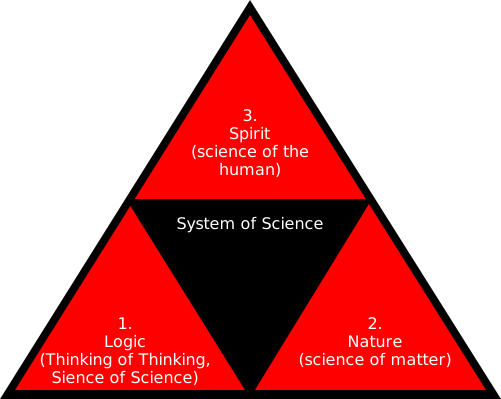
This distinction hits Hegel’s dialectic at a sensitive point. Hegel’s Logic proceeds systematically, not chronologically. The categories develop through conceptual necessity, not through temporal succession. Only in the Philosophy of Nature does time appear as a dimension of change - but even there it remains a form of externality, not the essence of the matter itself.
Bergson reverses this priority. Duration is the primary, the concept the secondary. We first experience the flow, the melody, the stream of consciousness. Only afterward do we break this flow into discrete moments, name the phases, order them conceptually. This subsequent ordering is not false - it is necessary for science and practice. But it does not capture the essence of time itself.
The Élan Vital: Creativity against Mechanism
L’Évolution créatrice (1907) develops this insight into a metaphysics. Evolution is neither mechanical adaptation (as in Darwin) nor the teleological realization of a plan (as in Lamarck), but élan vital - a creative life-drive that brings forth the new. Life invents itself, creates forms that were not previously possible. This creativity cannot be derived from what came before, cannot be conceptually anticipated. It is radically new.
Here lies the real challenge for Hegel. Hegel’s system is teleological: development follows an inner logic that becomes recognizable as necessary only in retrospect. Bergson insists: life is not necessary but contingent. Evolution could have proceeded otherwise. Every new form is creation, not logical consequence.
The legitimate insight is clear: there are qualitative dimensions that resist quantification. The intensity of a feeling, the character of a melody, the uniqueness of a moment - none of this can be captured by adding up units. Extensive magnitude (quantitative measurement) misses intensive magnitude (qualitative strength).
Intuition versus Concept: A False Alternative?
Bergson formulates his position as a radical alternative: either intuitive grasp of duration or conceptual dissection. Intuition - “la sympathie par laquelle on se transporte à l’intérieur d’un objet” - places us inside the thing, lets us experience duration directly. The concept remains outside, circles the thing, grasps it only indirectly through comparison with something else.[1]
This opposition seems to radically contradict Hegel’s dialectic. Hegel had shown that immediate intuition is empty, that determinacy arises only through mediation, through the concept. Bergson asserts the opposite: immediate intuition is rich, the concept poor. Mediation misses the essential.
Yet on closer inspection, Bergson’s position is more differentiated. Intuition is not simply immediately given - it must be worked out. Bergson speaks of an “effort” of intuition, an exertion needed to break through habitual patterns of thought. Intuition presupposes methodical discipline: one must learn to suspend the spatial-conceptual approach in order to grasp duration.
Here a structural affinity to Hegel’s concept of immediacy as result becomes apparent. Philosophical intuition in Bergson is not naive perception but mediated immediacy - the result of a process of liberation from inadequate forms of thought. One must go through the concept in order to arrive at intuition.
Integration: The Performative Dimension
Integrating this insight requires no abandonment of the dialectical method, but rather its refinement. In our interpretation of Hegel, the performative dimension is developed as constitutive. The Logic does not begin with abstract definitions but with the enactment of thinking itself. “Enacted action as original unity” is the living practice from which conceptual reflection springs.[2]
This performative dimension corresponds structurally to Bergson’s intuition. It is not outside the concept, but it precedes it. We already think before we reflect on thinking. We live in time before we conceptualize time. The task of philosophy is not to deny this immediacy but to bring it to self-reflection.
The “three circles” - performative, chronological, systematic - integrate Bergson’s insight.[3] The performative circle takes lived practice as its starting point. The chronological circle takes into account historical development. The systematic circle orders the categories according to their logical structure. These three perspectives are not alternatives but complementary.
Bergson’s critique hits a real tendency in Hegel’s presentation. The Science of Logic proceeds systematically-deductively. The chronological development, the historical genesis of the categories, remains implicit. The impression arises that the Logic is timeless - as if the categories were developed without reference to living practice. A processual interpretation of Hegel corrects this impression.
Henri Bergson: Introduction à la métaphysique, in: Revue de Métaphysique et de Morale, 1903. English: Introduction to Metaphysics. ↩︎
Kai Froeb, Hegel’s Science of Logic (in preparation), Ch. 2.2, Enacted action as original unity. ↩︎
Hegel’s Science of Logic (in preparation), Ch. 25.3, The Three Circles - Performative, Chronological, Systematic. ↩︎