Schelling: The Ontological-Existential Fundamental Critique
This text is a preview of History of the Reception of Hegel, volume I, to be published in 2026 by Reflexivity Press.
The Historical Constellation – The “Anti-Hegel” in Berlin
When Friedrich Wilhelm Joseph Schelling was called to Hegel’s former Berlin chair in 1841, he was already an old man of 66 — but at the same time the only living philosopher able to argue on equal terms with Hegel. His lectures on the “Philosophy of Mythology and Revelation” (1841–1846) became an intellectual event of the first rank — not because of their constructive achievements, but because of their systematic critique of Hegel.[1]
In the lecture hall sat Kierkegaard, Marx, Engels, Bakunin, Burckhardt — an entire generation of future Hegel critics was shaped by Schelling’s interpretation. The Prussian crown had not called Schelling by chance: Friedrich Wilhelm IV expected him to “destroy the dragon’s seed of Hegelian pantheism.”[2] Schelling fulfilled this mandate — though in his own systematic-philosophical way, not as a mere apologist for reaction. His significance lies not in what he himself constructed, but in the way he interpreted and criticized Hegel — thereby establishing an image of Hegel that would shape the entire post-Hegelian debate.
Schelling’s systematic position is unique. He himself had participated in the emergence of German Idealism, had worked alongside Hegel, and knew the system from the inside. His critique is no external polemic, but the attempt at an alternative — a different systematic philosophy meant to avoid Hegel’s supposed errors.
The Fundamental Critique – “Negative” versus “Positive” Philosophy
Schelling’s fundamental objection is precisely formulated: Hegel’s “negative philosophy” — logic — explains only the “what” (the essences), not the “that” (existence). “Pure thought […] deals only with possibilities, never with actual existence.”[3]
The systematic structure of his critique reads as follows:
- Negative philosophy: can develop a priori what God, world, and human being would be, if they existed
- Positive philosophy: must explore empirically that and how they actually exist
- Hegel’s alleged error: the confusion of logical possibility with real existence
The famous formulation runs: “Because pure thought has being as its result, it believes it has real being, but it has only the being of thought.”[4] Logic moves within the space of possibilities — it shows what can be coherently thought in conceptual terms. But it cannot show that something really exists. The “that” of existence remains external to logic.
The Concrete Execution of the Critique
The problem of the “presuppositionless beginning”: Hegel’s “pure being” at the start of the Logic is supposed to be absolutely presuppositionless. But is it really? Schelling insists: pure being is not presuppositionless, but already presupposes the thinking subject that carries out this abstraction. “Pure being is […] not the beginning, but the result of abstraction from everything that exists.”[5] The supposedly absolute beginning is already mediated by the act of abstraction.
The critique of the transitions: The famous “transitions” of Hegelian logic — from being to nothing to becoming, from quality to quantity, and so on — are said to be illusory movements. “Thought does not really move, but merely reflects the movement that takes place outside itself.”[6] The dialectical development is not a real development, but only the subsequent conceptual articulation of what has already happened.
The problem of the “absolute idea”: It is not the truth of reality, but only the truth of thought about reality. Hegel is said to have taken “logical sequence for real sequence.”[7] The necessity with which one category follows from another is logical necessity — not ontological necessity. That reality itself follows this logic still remains to be shown.
“Positive Philosophy” as Alternative
Schelling’s program: a philosophy that starts from “immemorial existence” and shows how consciousness, culture, and religion develop out of it historically. Not a priori construction, but an “empirical” philosophy of history — where “empirical” here means mythology and the history of revelation as the documents in which the Absolute interprets itself.
The systematic innovation is remarkable: the transition from philosophy of identity to philosophy of history. The Absolute realizes itself not logically-timelessly, but historically-temporally. The mythologies of peoples are not mere errors to be overcome by philosophy, but necessary stages in the self-revelation of the Absolute. History is not the application of logic, but an independent process.
But this “positive philosophy” remains problematic. It lapses into mythology instead of methodical further development. Instead of thinking the dialectic further, Schelling returns to pre-rational material. Exegesis of mythological texts takes the place of conceptual development.
The performative problem is obvious: Schelling seeks an “immemorial existence” before thought — but this search is itself thought. Who is supposed to think and assert this “pre-thought” existence? The attempt to think what precedes thought is performatively self-contradictory. The immediate can only be known as a result of mediation — precisely what Hegel had shown.
The systematic inconsistency also shows in that Schelling criticizes Hegel’s alleged apriorism but himself develops an a priori scheme of historical phases (mythology -> revelation -> philosophy). The difference from Hegelian dialectic lies not in apriority as such, but in the material that is ordered a priori.
The Legitimate Insight – And the Systematic Misunderstanding
The legitimate insight is clear and consequential: logic cannot explain why there is something at all rather than nothing. The “that” of existence is logically contingent — it cannot be derived from concepts. This is a fundamental insight that any integration of Hegel must take into account. The question of the ground of existence exceeds the competence of logic.
Schelling’s discovery anticipates later developments:
- Philosophy of existence: “Existence precedes essence” (Kierkegaard, Sartre) — the priority of the that over the what
- Philosophy of history: temporality as a fundamental structure of being, not as an external form
- Hermeneutics: understanding as historically conditioned, not as the application of timeless principles
The systematic misunderstanding, however, lies elsewhere. Schelling attributes to Hegel a “panlogism” that Hegel never held. Hegel never claimed that everything real is a priori rational, or that the empirical world can be derived from pure logic.
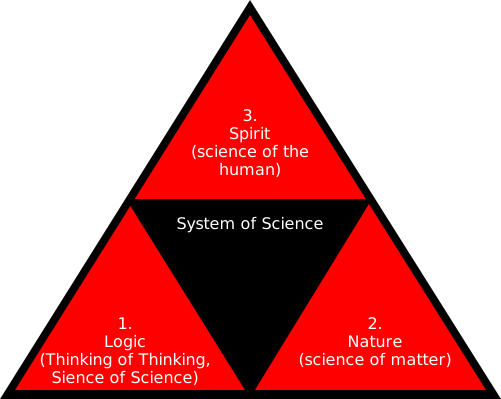
Hegel’s actual position is more differentiated: in the Encyclopedia, Hegel explicitly distinguishes three parts of his system: logic as the science of pure structures, philosophy of nature as the contingent realization of the idea in otherness, philosophy of spirit as the idea’s return to itself.[8] For Hegel, the transition from logic to nature is the “release” of the idea into freedom — a transition that cannot be logically deduced.[9]
Logic explicates the structures of thought, not the contents of the world. “Everything real is rational” means: the real is knowably structured, not: it is good or a priori derivable. The absolute idea is the self-reflection of method, not a metaphysical world-essence. That the world exists is a fact, not a logical derivation. How we understand the existing world in its structure — that is what logic explicates.
Schelling’s fight thus targeted a phantom — a dogmatic distortion of Hegel, not Hegel himself. But through Schelling’s authority, this distortion became the dominant image of Hegel.
Integration from the Perspective of Our Interpretation of Hegel
Schelling’s critique captures the contingency of existence. The world is the “other” of logic. This thought is found in Hegel himself — in the distinction between logic and real philosophy, in the transition from the idea to nature as the “release” of the idea into otherness.
In our interpretation this is developed explicitly: logic has three limits.[10]
- It performatively presupposes the You — whoever argues presupposes an interlocutor. Logic cannot derive its own dialogical structure from itself.
- It does not cognize the concrete world — empirical reality is contingent, not logically deducible.
- It knows its own limitedness — and therefore compels the transition to real philosophy.
Logic does not claim to ground existence. It explicates the structures under which we can understand what exists as rational — but that it exists is a fact, not a logical derivation. Schelling’s legitimate insight — that reality is more than pure logic — is sublated:
- Preserved: the resistant character of experience as a constitutive moment of truth
- Overcome: the search for “pre-thought” existence as performatively inconsistent, and the fight against the phantom Hegel
- Raised to a higher level: the integration of logical structures and resistant material in the living process of cognition
The History of Influence – Shaping the Post-Hegelian Image of Hegel
Schelling’s influence does not lie in his own construction — “positive philosophy” found little resonance and quickly fell into oblivion. His influence lies in the fact that he alerted an entire generation to a particular problem while simultaneously establishing a distorted image of Hegel that would shape the whole of post-Hegelian critique.
The immediate effect on his listeners:
Kierkegaard adopted Schelling’s critique of existence, but developed it further in an anti-Hegelian direction toward the leap and the philosophy of paradox. In doing so he took over the distorted image of Hegel as the “abstract systematizer” who dissolves the existing individual into the system. His radical opposition of existence and system, of leap and mediation, of individual and universal, follows Schelling’s polarizations — not Hegel’s differentiated position. (See section 5.3 in detail)
Marx and Engels adopted Schelling’s critique of praxis — the insight that “life determines consciousness,” not the reverse. But they turned this critique materialistically against Schelling’s theosophy and against the “speculative idealist” Hegel. They too fought against the “speculative” Hegel that Schelling had constructed — not against Hegel’s actual mediation of theory and practice. (Cf. Chapter 4)
The anarchists (Bakunin) politically radicalized Schelling’s critique of the system as an instrument of domination. The system as such became the enemy image — spontaneity against structure, freedom against order, life against the concept.
The long-term shaping of the image of Hegel:
Schelling established the caricature of Hegel as:
- ”Panlogist”: everything is dissolved into “mere logic” — although Hegel explicitly emphasized the limits of logic and developed real philosophy as an independent domain
- ”System fanatic”: living reality is sacrificed to the abstract system — although Hegel developed “life” as the first form of the idea, and dialectic was precisely meant to capture the movement of the living
- ”Conservative”: what exists is justified as “rational” — although Hegel systematically grounded critique and development and distinguished the “rational” from the merely existent
This caricature shaped the entirety of post-Hegelian critique — often without direct reading of Hegel, but through the mediation of his listeners and their students. Almost all later critics of Hegel reproduce variants of his misunderstandings:
- Trendelenburg: the logical-methodological refinement of the critique of transitions — but directed against the real Hegel (see Chapter 7.2)
- Kierkegaard: the existential-ethical radicalization of the critique of existence against the “abstract systematizer” (see section 5.3)
- Marx: the materialist-practical turn of the critique of reality against the “speculative idealist” (cf. Chapter 4)
- Nietzsche: the genealogical-power-analytic destruction of the “fanatic of reason” (see sections 4.7 and 6.3)
The tragic irony: many of the most productive critiques of Hegel fought against Schelling’s phantom Hegel rather than against the real Hegel — and thereby missed genuine points of connection for a constructive further development.
Schelling as Both Pathfinder and Wrong Turn
The paradoxical significance of Schelling for the reception of Hegel lies in the fact that he was both a pathfinder and a wrong turn for post-Hegelian development.
As pathfinder:
- He recognized the problem of existence as a limit of pure logic — even if he misunderstood Hegel’s position on this
- He anticipated the historicity of thought — the insight that philosophy grasps its time in thoughts
- He opened up the question of the “otherness” of the other — of what seems to elude conceptual mediation
As wrong turn:
- He lapsed into mystification instead of methodical further development — positive philosophy as mythological speculation
- He returned to mythology instead of reflective integration — regression instead of progress
- The privileging of “immemorial existence” over the concept was later, detached from Schelling’s theological intentions, to open gateways for political irrationalisms (see Chapter 28)
- He established false alternatives (logic vs. existence, system vs. life, concept vs. reality) and false images of Hegel instead of dialectical mediation
The systematic lesson to be drawn from Schelling’s failure is clear: the legitimate insights — the contingency of existence, the historicity of thought, the resistant character of experience — must be integrated without falling into his aporias and without fighting phantoms. The task is to pose and answer the right questions without giving up the systematic power of dialectic.
Schelling’s lasting merit: he was the first to show systematically that important questions remain open — even though he often posed these questions wrongly and fought against caricatures. The unresolved task that runs through the entire history of the reception of Hegel remains: the integration of Schelling’s legitimate insights into a further-developed dialectic that neither reproduces his mystifications, nor adopts his distortions of Hegel, nor ignores his real problems.
Friedrich Wilhelm Joseph Schelling: Philosophie der Mythologie (lectures 1841–1846), in: Sämmtliche Werke, ed. K.F.A. Schelling, sec. 2, vols. 1–2, Stuttgart 1856–1858; idem: Philosophie der Offenbarung (lectures 1841–1846), in: Sämmtliche Werke, sec. 2, vols. 3–4, Stuttgart 1858. ↩︎
documented e.g. in “Aus Schellings Leben in Briefen – Dritter Band 1821–1854,” pp. 35–37. Edited by S.L. Plitt. S. Hirzel Verlag, Leipzig 1870. See Froeb 2020 on the quotation ‘destroy the dragon’s seed of Hegelian pantheism’ ↩︎
Schelling: Philosophie der Offenbarung, Sämmtliche Werke sec. 2, vol. 3, lecture 8. ↩︎
Schelling: Philosophie der Offenbarung, Sämmtliche Werke sec. 2, vol. 3, lecture 8. ↩︎
Schelling: Zur Geschichte der neueren Philosophie (Munich lectures 1827), in: Sämmtliche Werke, sec. 1, vol. 10, Stuttgart 1861, lecture 4. ↩︎
Schelling: Philosophie der Offenbarung, Sämmtliche Werke sec. 2, vol. 3, lecture 10. ↩︎
Schelling: Zur Geschichte der neueren Philosophie, Sämmtliche Werke sec. 1, vol. 10, lecture 4. ↩︎
Hegel: Encyclopedia of the Philosophical Sciences in Outline (1830), §§ 18–25 (Division of Philosophy), Werke vol. 8, Frankfurt/M. 1970. ↩︎
Hegel: Encyclopedia § 244, Werke vol. 9, pp. 19–20: the idea “freely releases itself as Nature.” ↩︎
See in detail: Kai Froeb, Hegel’s Science of Logic (in preparation), Ch. 23.5, The Logically Bounded Absoluteness – Why Logic Cannot Remain with Itself, Chapter 24.1 (The Twofold Transition to Real Philosophy). ↩︎