What Does Hegel Say About the Question of God? – A Methodological Clarification
This text is a preview of History of the Reception of Hegel, volume II, to be published in 2026 by Reflexivity Press.
Why This Clarification Is Necessary
Before presenting the Protestant positions on Hegel, we must clarify a fundamental question: What does Hegel himself say about God? The answer is more complex than the polemics on both sides suggest – and it requires a distinction that is often overlooked.
Logic and Philosophy of Religion – Two Levels
Hegel’s statements on the question of God are distributed across two different areas of his work, which make different kinds of claims:
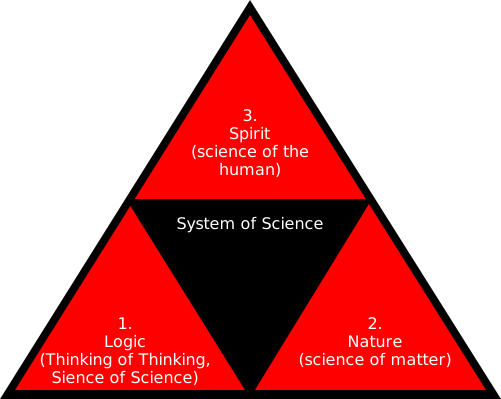
The Science of Logic develops the pure structures of thought – that which we cannot think away without already presupposing it. In the famous passage from the introduction, Hegel writes that logic is “the realm of pure thought,” “truth as it is without veil in and for itself.” And then, with a telling caution: “It can therefore be said that this content is the exposition of God as he is in his eternal essence before the creation of nature and a finite mind.”[1]
Hegel does not say: “This is God.” He says: “One can express it this way.” Logic shows the pure structures of thought – what is systematically more fundamental than anything concrete. In this sense, the “thoughts of God before creation” are the logical structures themselves – not temporally prior, but systematically more basic. But Hegel expressly qualifies this: logic is “still only the abstract idea” – it shows the minimum, not the maximum, of what can be meant by “God.”
The Lectures on the Philosophy of Religion go further. Here Hegel writes: “God as spirit is essentially this self-revealing; he does not merely create the world once, but is the eternal creator, this eternal self-revealing, this act.”[2] And on the Trinity: “The absolute, eternal idea is, in and for itself, God in his eternity, before the creation of the world, outside the world.”
Here Hegel is not agnostic. He says: God is spirit, is essentially self-revelation, is trinitarian in structure. The Trinity becomes the structure of spirit itself: the Father is the eternal idea in the element of thought; the Son is its externalization into finitude and nature; the Holy Spirit is the community, the living spirit in the practice of mutual recognition.
Different Directions of Interpretation
Hegel’s texts – especially the philosophy of religion – have generated a rich history of interpretation. It is important to distinguish different directions without prematurely judging which one is “correct.”
The “metaphysical” reading (prominently represented by, for instance, Charles Taylor) understands Hegel as a cosmic ontologist: spirit really realizes itself in the world, God is spirit, the idea actually externalizes itself. This reading takes Hegel’s formulations at their word and sees in them his true achievement: a comprehensive metaphysics of the self-knowing Absolute.
The “anti-metaphysical” readings (Pippin, Pinkard, Brandom) read Hegel as a consistent post-Kantian: logic explicates the conditions of rational norm-giving, “spirit” is social practice, the categories are normative structures. These readings contain important insights – but they tend to reduce Hegel’s ontological dimension.
The “anti-mystical” readings (Pirmin Stekeler-Weithofer, and, in a related but not identical way, the present account) differ from both. They are not anti-metaphysical – they do not reduce Hegel to normativity or sociology. But they strive for complete intelligibility and traceability by “translating” Hegel’s formulations.
Stekeler understands “God” as a name for the “instance of absolute truth” that transcends every finite act of holding-something-to-be-true. “Spirit” is the “We-subject” of human rational practice – “the form of cooperation and ethical life of humanity as one.” The Trinity becomes the “logical grammar of spirit.”[3]
Our reading shares with Stekeler the concern for intelligibility, but holds the question of God more open: when Hegel says “the idea resolves itself,” this is shorthand for: we, insofar as we have fully thought through the logic, recognize the necessity of the transition. The “thoughts of God before creation” are the pure logical structures – systematically more fundamental, not temporally prior. But whether these structures are thought by a personal God or are themselves the Absolute remains an argumentatively open question.
This is the decisive point: logic is compatible with both theistic and atheistic worldviews, but it compels neither. It exhibits the rational structures that every worldview must think through – but the interpretation of these structures remains philosophically open. This is a more radical form of enlightenment than dogmatic atheism: not the elimination of the question of God, but its methodically controlled treatment.
Overcoming the False Alternative
The debate “metaphysical vs. anti-metaphysical” possibly misses the point. One side holds that Hegel’s unity of thought and being is a cosmic ontology – that spirit realizes itself in the world. The other tries to translate this into something sociological or normative in order to avoid metaphysics.
But the key is simpler: the supposed “comparison” between spirit and world never actually takes place. Everything happens within consciousness – but within consciousness there are moments that resist our arbitrary will. These resistances point the way toward objectivity. “Inside” and “outside” are not separate worlds, but distinctions within experience.
Thought does not open up the world by producing it – it opens up the world by encountering resistance. This is Hegel’s unity of thought and being: not mystically asserted, but experienced in the very act of seeking truth. The alternative “either thought fails to reach the world (Kant) or it produces the world (idealism in the bad sense)” is false. The third possibility: thought reaches the world by encountering its resistance.
This is neither “cosmic ontology” nor “mere normativity.” It is the dissolution of the false alternative – and it shows why all serious readings of Hegel have more right on their side than the polemics on either end suggest.
What unites all serious readings: Hegel takes religion seriously. He does not criticize faith, but a “shallow” Enlightenment that, along with metaphysics, disposes of the question of meaning as well. Religion gives human beings a stance toward the “whole of being” – an achievement that merely critical reason cannot replace.
This distinction matters for everything that follows: Barth’s critique, Pannenberg’s rehabilitation, Moltmann’s mediation – all presuppose knowing which Hegel is meant. And the objections we are about to examine hit none of these serious interpretations of Hegel – they hit a caricature.
—
G.W.F. Hegel, Science of Logic I, Introduction. The formulation “it can therefore be said” shows Hegel’s caution: he does not claim that logic is God, but that one can understand it this way. ↩︎
G.W.F. Hegel, Lectures on the Philosophy of Religion, Part III: The Consummate Religion. Here Hegel goes beyond mere logic and positively determines God as spirit that reveals itself. ↩︎
Pirmin Stekeler-Weithofer, Hegels Philosophie der Religion, 2024. Stekeler develops the “demystifying” reading most consistently: “God” as a name for the instance of absolute truth, “Spirit” as the We-subject of rational practice. ↩︎