GDR Philosophy of Science as Counterpoint
This text is a preview of History of the Reception of Hegel, volume II, to be published in 2026 by Reflexivity Press.
A Different Tradition
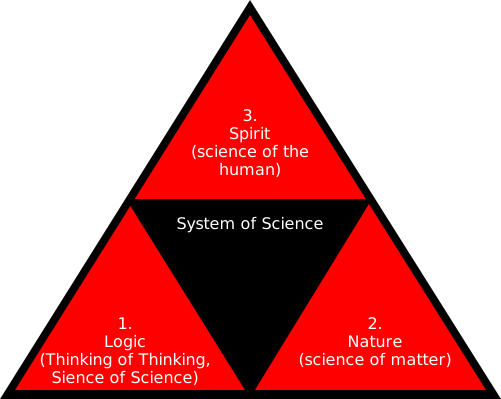
While in the West Kuhn, Lakatos, and Feyerabend were debating, a different philosophy of science developed in the East – the Marxist tradition, cultivated especially in the German Democratic Republic (GDR, East Germany). It had an explicit reference to Hegel: dialectics was meant to explain the development of science. But it also had a dogmatic streak: the “dialectical laws” were often treated as ready-made rules that could be “applied” to science.
Warnke, Wahsner: Hegel for the Natural Sciences
Camilla Warnke and Renate Wahsner developed a more nuanced position. They showed that Hegel’s philosophy of nature is not simply “outdated” – it contains insights relevant to modern physics: the critique of atomism, the emphasis on relation, the question of the relationship between mathematics and physics.
This is not an uncritical apology for Hegel. Warnke and Wahsner know that Hegel’s concrete statements about nature are often wrong. But his method – the question of the conceptual structure of natural science – remains fruitful.
East-West Parallels
Both traditions – the Western post-positivist and the Eastern Marxist – criticize naive empiricism, emphasize the conceptual dimension of science, and view science as a historical process. The differences lie more in style (the West historical-sociological, the East philosophical-systematic) and in political embedding.
—