Marx's Self-Interpretation and the Dialectic of Distancing
This text is a preview of History of the Reception of Hegel, volume I, to be published in 2026 by Reflexivity Press.
In the afterword to the second edition of Capital (1873), Marx explicitly reflects on his method. The passage is famous — and equally puzzling: “My dialectic method is not only different from the Hegelian, but is its direct opposite. To Hegel, the life-process of the human brain, i.e., the process of thinking, which, under the name of ‘the Idea’, he even transforms into an independent subject, is the demiurgos of the real world, and the real world is only the external, phenomenal form of ‘the Idea’. With me, on the contrary, the ideal is nothing else than the material world reflected by the human mind, and translated into forms of thought.”[1]
This formulation seems unambiguous: Marx inverts Hegel, sets him “on his feet” instead of “on his head.” But the formulation is misleading. For what Marx here calls the “direct opposite” is in truth an explication of what is already latent in Hegel.
Hegel’s “Idea” is not a transcendent being beyond reality, but the immanent structure of reality itself. When Hegel speaks of the “thinking process,” he does not mean subjective representations in the head, but the objective forms of the rational structure of the world. For Hegel, the “Idea” is nothing other than reality insofar as it is comprehended — not a beyond, but the structure of the real become transparent to itself.
Marx’s formulation of the material “reflected by the human mind, and translated into forms of thought” describes exactly the enactment of action as the original unity of the ideal and the material. Thinking is not a mere mirroring of external things, but a practice — an active appropriation of reality that simultaneously transforms this reality. Precisely this structure is present in Hegel — only that he formulates it not as “material practice” but as the “self-movement of the concept.”
The legitimate distancing lies elsewhere. Marx is reacting to real tendencies in Hegel’s presentation that invite mystifying interpretations. Hegel’s talk of “absolute spirit,” of the “cunning of reason,” of “world history as world tribunal” suggests a supra-individual power that asserts itself behind the backs of individuals. Marx unmasks this suggestion: the “cunning of reason” is nothing other than the unintended consequences of individual actions within a social nexus not seen through.
Marx continues: “The mystification which the dialectic suffers in Hegel’s hands, by no means prevents him from being the first to present its general form of working in a comprehensive and conscious manner. With him it is standing on its head. It must be turned right side up again, if you would discover the rational kernel within the mystical shell.”[2]
The irony of this formulation becomes visible only from a systematic perspective. What Marx criticizes as “mystification” is not the dialectical method itself, but its idealist self-interpretation. Hegel’s own presentation of his method invites misunderstandings — but the method itself, as practiced, is not mystical. The “turning right side up” consists not in changing the method, but in correctly interpreting it.
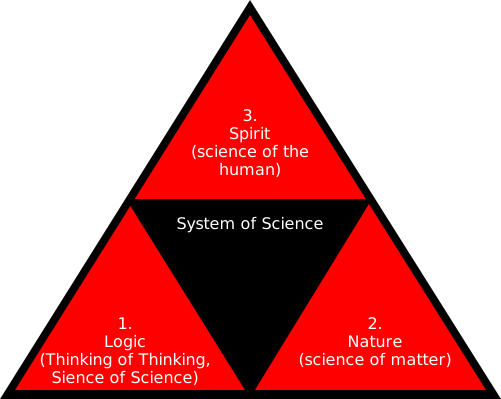
Marx could not recognize that his emphasis on “sensuous human activity” was already latent in Hegel’s conception, because Hegel had not explicitly developed this dimension. Hegel’s Logic remains at the level of pure conceptual development — the application to nature and spirit occurs only in the philosophy of the real (Realphilosophie). But precisely this separation produces the appearance that logic is a merely ideal construction subsequently “applied” to reality.
Marx’s achievement consists in carrying through the method on an object that Hegel had treated only in outline, and doing so with a thoroughness that extends down to factory reports and statistics. It would be wrong to say that Hegel himself had not applied it — the philosophy of the real carries it through nature, anthropology, law, art, religion, and history. Through this it becomes visible that the dialectic is not a speculative construction but the real form of movement of social relations themselves. The contradictions are not errors of thought but objective structures of the capitalist mode of production.
One occasionally reads that the distancing was methodologically necessary: that, as an orthodox Hegelian, Marx would have tried to derive political economy from logic. This explanation does not hold up. No Hegelian, Hegel included, ever attempted to derive objects from logic; they attempted to present the logic of their objects. And it is not evident why a science of conceptual thought should be unsuited to a particular object. Marx himself speaks against this: in a letter to Engels written during the work on the Grundrisse, he reports that leafing through Hegel’s Logic again had been of great service to him for the method of treatment.
What the distancing accomplishes is more modest. It is a position taken within a field in which Hegel’s name stood for the justification of the existing order. And it has one consequence that benefits the work: whoever cannot appeal to any authority must develop every determination from the object itself.
This unresolved self-interpretation has a biographical parallel that is methodologically illuminating. Marx not only names Hegel, for the most part, only as a figure of distancing — he also barely names Eduard Gans, his most important academic teacher in Berlin, in his published writings. Gans, who taught Hegelian philosophy of right with greater influence than Hegel himself, who methodically turned the passage on the rabble (Pöbel) and formulated the class formula that later recurs in the Manifesto, appears in Marx’s work not as a cited source but as an absorbed form of thought. Both things — the distancing from Hegel and the silence about Gans — follow the same logic: a method that has truly been absorbed no longer needs to be named as method; it is at work in the very enactment of the matter itself. Sublation in the Hegelian sense — passed through, not refuted; preserved as form, not cited as source — describes Marx’s relation to his teachers more precisely than the polemical self-stylization of the “turning right side up.”