Systematic Assessment: What Remains of Hegel after All This Suffering?
This text is a preview of History of the Reception of Hegel, volume II, to be published in 2026 by Reflexivity Press.
The Movement of the Chapter – Looking Back
We began with the question: can one still read Hegel after Auschwitz? Three existential answers, an academic clarification, a political excursus. Now the systematic balance.
Levinas showed the limit of totalization – the face of the Other withdraws from the system. But he himself could not escape systematicity: whoever writes books, philosophizes, argues, practices mediation.
Jonas developed a theology of the powerless God – God cannot intervene, so we must act. But this God hardly differs any longer from the absence of God. The practical consequence is the same: human responsibility.
Fackenheim formulated the 614th commandment – Hitler must not win posthumously. Dialectic becomes an open task: not guaranteed reconciliation, but hoped-for repair (Tikkun). This comes closest to Hegel – and at the same time shows what must be corrected in him.
The academic researchers (Yovel, Avineri, Rotenstreich) showed: one can work soberly with Hegel, see his limits, use his strengths. Hegel was not an anti-Semite – but his system had weaknesses.
The Israel excursus showed the real dialectic: security for persecuted Jews and justice for Palestinians – a tension that cannot be resolved theoretically, only worked on practically.
Now the systematic question: what follows from this for Hegel?
Thesis 1: The Question Is Not Only “After Auschwitz,” but “After All Suffering”
The Jewish philosophers formulated their question out of specific experience: the Shoah – the systematic annihilation of six million Jews. This experience was, for them, existential, immediate, unavoidable. Their philosophy carries this shock in every sentence.
But systematically their question is not singular. The question “How can one still believe in reason, reconciliation, progress after this catastrophe?” arises after every great suffering:
-
After colonialism – centuries of enslavement, exploitation, annihilation of entire peoples. The number of victims far exceeds that of the Shoah. Millions of Africans in the transatlantic slave trade, millions of Indigenous peoples in the Americas, millions in the Congo (10 million under Belgian rule), in India (famines under British rule), in China (Opium Wars).
-
After Stalin’s terror – 20 million victims through collectivization, the Gulag, the “Great Purge.” The Soviet Union promised liberation, brought new oppression.
-
After the Second World War as a whole – 27 million Soviet dead (half of them civilians), Chinese victims (estimated 15-20 million), German civilians (bombing war, expulsion), Japanese civilians (Hiroshima, Nagasaki). The Shoah was the most systematically planned, most industrially organized genocide – but not the only one.
-
After every genocide – Armenians (1915), Herero and Nama (1904-08), Rwanda (1994), Bosnia (1995), and many more.
The Jewish philosophers have formulated the question urgently – because they were existentially affected, because they wrote within the Western philosophical tradition, because their voices were heard. But their answers hold universally: for every suffering, every genocide, every catastrophe.
The Systematic Consequence: not “after Auschwitz one can no longer naively read Hegel,” but: “after the history of suffering, one can no longer naively read Hegel.” The Shoah is the sharpest concentration of this question – but not its only instance.
Thesis 2: Hegel’s Philosophy of History Was Never Deterministic – The Misunderstanding
Much of the critique of Hegel rests on a fundamental misunderstanding: that Hegel was a “historical optimist,” who claimed that history develops automatically toward the good, that world spirit unfolds necessarily, that reconciliation is guaranteed.
This image of Hegel is false.
What Hegel Really Said
Hegel did not say: “The future will necessarily be good.”
Hegel said: “Looking back, we can understand why it came to be this way – and learn from it.” The famous formula: “The owl of Minerva begins its flight only with the falling of dusk.”[1] This means: philosophy comes after the deed. It understands the past – it does not prognosticate the future.
Hegel’s philosophy of history is retrospective, not prospective. It explains how we arrived at modernity – not where modernity leads.
Freedom Is No Natural Necessity
Hegel in the Philosophy of Right: “The ground of right is, in general, the spiritual, and its more precise place and starting point is the will, which is free.”[2] Freedom is not insight into necessity (that would be Spinoza), but self-determination.
What does that mean? Reason is not in history like a thing that unfolds automatically. Reason exists in history through us human beings. We give ourselves laws, we create institutions, we shape the world.
The famous “cunning of reason” does not mean: world spirit uses us as puppets. It means: humans act from their own motives (passion, interest, ambition) – but the consequences can exceed their intentions. This is not heteronomy, but insight into the unintended consequences of our action.[3]
So What About “The Actual Is Rational”?
The scandalous sentence from the preface to the Philosophy of Right: “What is rational is actual; and what is actual is rational.”[4]
Misunderstood: “Everything that exists is rational – so the Prussian police state is also rational.”
Correctly understood: Hegel distinguishes “actuality” (Wirklichkeit) from mere “existence” (Dasein). Only what reason realizes is actual – what was shaped through freedom. Mere existence (e.g., tyranny, injustice) is not actual in the philosophical sense.[5]
The sentence means: if something is actually rational (i.e., realizes freedom), then it also exists. And conversely: if something exists lastingly (not merely by chance), then it has rational grounds.
But the point is: who makes something rational? We human beings. History is not automatically rational – it becomes rational through us.
Fackenheim = Hegel Correctly Understood
Fackenheim’s “open dialectic” is not a deviation from Hegel, but an explication of what is already present in Hegel himself:
- Dialectic does not describe what happens automatically
- It explicates structures according to which we should act
- Reconciliation is not fact, but task
- Reason does not prevail automatically – we must make it prevail
The difference between Hegel and Fackenheim is not one of principle, but historically conditioned:
- Hegel wrote before the total catastrophe and could still be optimistic (reason prevails – because, looking back, he saw the Enlightenment)
- Fackenheim writes after Auschwitz and must be skeptical (reason prevails only if we fight for it – because, looking back, he sees the catastrophe)
But both say: it is we who make the world rational – or fail to.
Thesis 3: “Sublation” Is Not Annihilation – The Second Misunderstanding
A second fundamental misunderstanding concerns sublation. Yovel criticized: Hegel says Judaism is “sublated” in Christianity – so Jews no longer have a right to exist.
This understanding is absurd – if applied consistently:
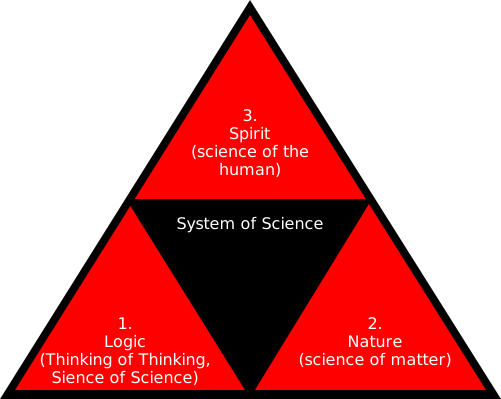
- Logic is sublated in nature -> so no more logic?
- Nature is sublated in spirit -> so no more nature?
- Mechanics is sublated in chemistry -> so no more mechanics?
- The family is sublated in civil society -> so no more families?
- Subjective spirit is sublated in objective spirit -> so no more individuals?
If “sublation” meant that the sublated disappears, then in the end only absolute philosophy would exist – everything else would be “overcome” and gone. This is obviously absurd.
What “Sublation” Really Means
Hegel himself defines sublation threefold:[6]
1. Negating: the immediate form is negated (the family as the only social form, mechanics as the only natural lawfulness, Judaism as the only conception of God)
2. Preserving: the content remains (there continue to be families, mechanics continues to operate, Judaism continues to exist)
3. Raising to a higher level: integration into a more complex system (family AND civil society AND state; mechanics AND chemistry AND biology; Judaism AND Christianity AND secular ethics)
Applied to Judaism
What Hegel does NOT say: “Jews should disappear” or “Judaism no longer has a right to exist.”
What Hegel says (or would systematically have to say): “The ancient Jewish form of religion (Temple Judaism, sacrificial cult, God as absolutely transcendent without mediation) is historically overcome – but Judaism as a living tradition continues to develop.”
And indeed: Judaism developed radically after the destruction of the Temple (70 CE):
- Rabbinic Judaism arose (Talmud, Mishnah)
- Diaspora communities developed their own structures
- In the Middle Ages: Jewish philosophy (Maimonides), mysticism (Kabbalah)
- In modernity: Reform Judaism, Orthodoxy, secular Judaism, Zionism
Judaism was not “sublated” in the sense of “having disappeared,” but in the sense of: transformed, further developed, raised to new levels.
Hegel’s Empirical Error
Hegel’s error was not the logic of sublation itself, but empirical blindness: he did not see (or not sufficiently) that Judaism was developing dynamically. He thought it was “frozen” at an old stage – that is a historical error, not a systematic flaw in his dialectic.
This blindness was typical of the era – many Christian thinkers of the nineteenth century regarded Judaism as “outdated.” But that was prejudice, not a logical consequence of the dialectic.
The Systematic Correction: sublation means co-existence at a higher level, not replacement. Judaism, Christianity, Islam, secular ethics – all are shapes of spirit that coexist, influence one another, develop further. None “sublates” the other in the sense of annihilation.
Thesis 4: The Universal Lesson – Not Particularism, but Universalism
Now the most difficult question: what lesson follows from Auschwitz? Two answers are on the table:
Particular: “Jews need their own state, so as never again to be defenseless. ‘Never again’ means: we must be powerful, if necessary by force.”
Universal: “No one may ever again be a victim – not Jews, not Palestinians, no one. ‘Never again’ means: universal human rights for all.”
The Philosophical Tension
The first position is understandable – existentially comprehensible. Whoever has experienced persecution, pogroms, annihilation wants security. A state of one’s own seems to guarantee this security. This is the logic of nationalism: every nation needs its own state in order to protect itself.
But this position is particularist – it prioritizes one’s own group. And it can lead to violence against others: if one’s own security has absolute priority, then one may potentially violate the rights of others (expel, oppress, occupy Palestinians) in order to guarantee one’s own security.
The second position is Hegelian – universal. It says: the lesson from every suffering is not that one’s own group should never suffer again (at the expense of others), but that all human beings have rights, that no one may be a victim.
Israel as a Dialectical Tension
The founding of the state of Israel in 1948 shows this tension in all its sharpness:
On the one hand: a safe haven for persecuted Jews – after Auschwitz an understandable longing for security, for a place where one is not a minority, where one can defend oneself.
On the other hand: a settler-colonial project – land seizure, expulsion of 750,000 Palestinians (Nakba 1947-49), destruction of over 500 villages, establishment of ethnic hierarchy (Jews have a right of return, Palestinians do not).[7]
The irony – and it is painful, but must be spoken – is the following: a people that suffered under colonial-style extermination policy (Domenico Losurdo has convincingly shown the parallels between Nazi “Lebensraum” policy and European colonialism[8]) founds a state with settler-colonial structures.
Not all aspects of Israel are colonial – there are democratic institutions, a constitutional state, cultural diversity. But the founding phase (expulsion) and the occupation (since 1967: millions of Palestinians without full rights) have colonial features.
German Guilt and Its Displacement
A Jewish friend formulated the point sharply: “If the Germans – rightly – have such a great feeling of guilt toward the Jews that they wish them a state, why then do they not give them a federal state of their own country, say Schleswig-Holstein or Mecklenburg-Vorpommern?”
The question is provocative – but systematically justified. German guilt is not settled by German territorial cession, but through consent to the expulsion of third parties (Palestinians). The costs of “reparation” are paid not by the perpetrators (Germans), but by uninvolved third parties (Palestinians).
This is not a denial of Israel’s legitimacy – the state exists, millions of people live there, were born there, know no other homeland. The question is: can one acknowledge the founding injustice and at the same time accept the present reality? Can one say: “The expulsion of 1948 was injustice – but Israel has a right to exist today”?
Hegel would presumably say: yes – because “recognition” means acknowledging what has come to be, not only what is just. History is not only the realization of reason, but also violence, injustice, contingency. To acknowledge this does not mean to justify it – but it means to proceed from present reality and ask: how can justice be realized from here?
The Universal Answer
A Jewish philosopher said in a television debate: “The lesson of Auschwitz is not anti-anti-Semitism, but universal human rights for all.”
This is the Hegelian consequence – universal recognition. Not: “We Jews must never again be victims” (particular, can lead to violence of one’s own). But: “No one must ever again be a victim – not Jews, not Palestinians, no one” (universal, in solidarity).
This position does not mean: “Israel should disappear.” It means: Israel must place its foundation on universal principles – not ethnic exclusivity, but equal rights for all; not occupation, but recognition of Palestinian rights.
Whether that is realistic – that is the practical question, not a philosophical one. The philosophical question is: what would be rational? And the answer: a state that gives all its citizens equal rights (Jews, Arabs, everyone), that is not based on ethnic hierarchy, that recognizes its neighbors.
Thesis 5: Dialectic as Practical Task – Fackenheim’s Completion of Hegel
The Jewish philosophers after Auschwitz asked: can one still read Hegel? This chapter’s answer: yes – but transformed.
What Remains of Hegel?
1. Dialectic as structure: negation, mediation, sublation – these operations remain indispensable. One cannot think un-dialectically without falling into contradictions. Levinas tried it – and wrote systematic books. Jonas tried it – and used Hegel’s concepts.
2. Recognition as principle: mutual recognition remains the most fundamental ethical principle. Fascism was its total negation (see Volume 1, chapter on fascism). After Auschwitz it is clear: without recognition, no humanity.
3. Mediation against immediacy: one cannot go back to “original” immediacy (that was the fascist error). One must go through reflection, through mediation, through modernity – not around it.
4. Freedom as self-determination: not insight into necessity (Spinoza), not obedience to God (tradition), but self-legislation. We give ourselves laws – that is autonomy, that is modernity, that is reason.
What Must Be Corrected?
1. The certainty of reconciliation: Hegel could still be optimistic – the Enlightenment seemed to be winning, reason to be prevailing. After Auschwitz, after colonialism, after all suffering, it is clear: there is no guarantee. Reconciliation is possible, but not necessary. It depends on us.
2. Teleology: history has no necessary direction toward the good. It can also fail – as Auschwitz shows. The task is not to recognize teleology, but to create it: we must make history rational.
3. Sublation as co-existence: sublation does not mean that earlier stages disappear, but that they coexist at a higher level. Judaism, Christianity, secular ethics – all remain, develop, influence one another.
4. Eurocentrism: Hegel saw Europe as the peak of history. After the critique by postcolonial thinkers (whom we will treat in Volume 2, Part III), it is clear: all cultures are particularizations of the universal search for reason. No culture is “overcome,” all develop.
Fackenheim’s Completion
Fackenheim’s “open dialectic” is the best synthesis:
- The structure of dialectic remains (negation, mediation, sublation)
- But certainty disappears (no guaranteed reconciliation)
- Dialectic becomes a practical task (Tikkun – repair of the world)
- Responsibility lies with us (not with God, not with world spirit, not with history)
This is not a deviation from Hegel, but a radicalization of what is already present in Hegel himself: freedom as self-determination, history as our work, reason as effective through us.
Thesis 6: The Universal Task – For All, After All Suffering
The final thesis is the most comprehensive: the lesson from Auschwitz does not apply only to Auschwitz.
What We Do in This Book
We analyze the reception of Hegel from 1831-1989 – looking back. We understand what thoughts were thought, what purposes were pursued, where they failed, where they succeeded. We learn from history – not because it automatically leads to the good, but because we must learn from it.
This is exactly Hegel’s method: “The owl of Minerva flies only at dusk.” We understand after the deed. And precisely because fascism was the greatest catastrophe, it is the most urgent lesson: where does the total negation of reason lead? To annihilation. Therefore: never again.
But this lesson applies not only to fascism. It applies to every form of unreason:
- Colonialism – the denial of the humanity of the colonized
- Slavery – the reduction of the human being to a commodity
- Genocides – industrial annihilation
- Wars – the dehumanization of the enemy
- Totalitarianisms – the extinguishing of freedom
In all of this one sees the absence of the good, the non-application of principles. The four basic operations from Volume 1, Chapter 1 – self-application, differentiation, sublation, recognition – were violated. The nine ethical criteria were ignored.
The task is: to apply these principles. To understand evil (not excuse it!) and to sublate it. This happens through us human beings – not through God, not through history, not automatically.
The Answer to the Original Question
Can one still read Hegel after Auschwitz?
Yes – one must, even. But not naively, not affirmatively, not as a closed system. One must read Hegel as:
- Explication of structures according to which we should act
- Analysis of the past, from which we learn
- Call to practice, to make the world rational
- Critique of immediacy, which leads to barbarism
- Principle of recognition, which is more urgent after Auschwitz than ever
Fackenheim said it: the 614th commandment is “Hitler must not win posthumously.” But this holds universally: no one who committed injustice may win posthumously – neither Hitler nor Stalin, neither colonial masters nor slaveholders, neither genocidal murderers nor warmongers.
They win posthumously if we do not learn, do not act, do not change the world for the better.
Who should turn the world toward the good, if not us? That is the question the Jewish philosophers after Auschwitz posed. But it holds not only for Jews – it holds for all human beings, after every suffering.
That is the Hegelian consequence: we are the subjects of history. We must realize reason. We must practice recognition. We must enact the dialectic.
History is not automatically rational. But it can become rational – if we make it so.
That is the universal lesson – after Auschwitz, after colonialism, after all suffering. Never again means: never again for no one. Universal human rights for all – Jews, Palestinians, Africans, Asians, all.
This is Hegel’s dialectic, correctly understood: the freedom of all is the condition of the freedom of each individual. Not particularism (my group against others), but universalism (all human beings are free).
After Auschwitz, this insight is not refuted – it is more urgent than ever.
Note: The corrections of misunderstandings of Hegel developed in Chapter 8.7 have universal validity:
- Sublation means transformation, not elimination – applies to:
- Judaism in Christianity (Hegel’s example)
- African cultures in world culture
- Indigenous philosophies in world philosophy
- History is open, not determined – means:
- After Auschwitz: we must actively fight against repetition
- After colonialism: decolonization is an active task
- Today: all cultures jointly shape the future
- Recognition is performatively necessary – shown:
- In the Shoah: the refusal of recognition was self-contradictory
- In colonialism: likewise
- Today: recognition is not a grace, but a logical necessity
Hegel: Elements of the Philosophy of Right, Preface, TWA 7, p. 28. ↩︎
Ibid., §4, TWA 7, p. 46. ↩︎
Hegel: Lectures on the Philosophy of History, Introduction, TWA 12, p. 49: “Individuals disappear before the universal substance […] - and this constitutes the living reality and preserves itself through them.” ↩︎
Hegel: Elements, Preface, TWA 7, p. 24. ↩︎
On the distinction actuality/existence see: Michael Theunissen: Hegels Lehre vom absoluten Geist als theologisch-politischer Traktat, Berlin: De Gruyter, 1970, pp. 18–24; as well as Terry Pinkard: Hegel’s Phenomenology: The Sociality of Reason, Cambridge: Cambridge University Press, 1994, pp. 254–267. ↩︎
Hegel: Science of Logic I, TWA 5, pp. 113–115: “To sublate has a twofold meaning in the language: on the one hand it means to preserve, to maintain, and equally it also means to cause to cease, to put an end to.” ↩︎
On the Nakba see: Benny Morris: The Birth of the Palestinian Refugee Problem Revisited, Cambridge: Cambridge University Press, 2004 (despite contested interpretations, Morris’s documentation of the expulsions is empirically valuable); Ilan Pappé: The Ethnic Cleansing of Palestine, Oxford: Oneworld, 2006. ↩︎
Domenico Losurdo: Die Sprache des Imperiums. Kritik der ideologischen Vernunft (Italian 2007), German ed. Cologne: PapyRossa, 2010, esp. pp. 179–243. ↩︎