Ecological Critique: The Anthropocentrism of Reason
This text is a preview of History of the Reception of Hegel, volume II, to be published in 2026 by Reflexivity Press.
Hans Jonas: The Imperative of Responsibility
Hans Jonas, whom we have already encountered as a Jewish philosopher, develops in The Imperative of Responsibility (1979) an ecological ethics that goes beyond classical anthropocentrism.
His diagnosis: technological civilization has created a new situation. For the first time, human beings can destroy the very foundations of their own life. Nuclear weapons, environmental destruction, genetic manipulation — human power has grown so great that it can turn against humanity itself. Traditional ethics, which applied only to the here and now, is no longer sufficient.
Jonas formulates a new categorical imperative: “Act so that the effects of your action are compatible with the permanence of genuine human life on Earth.” The future becomes an addressee of ethical responsibility. We are obligated not only to the living, but also to those not yet born.
But Jonas goes further: nature itself has intrinsic value. It is not merely a means for human purposes, but an end in itself. Life as such — not only human life — deserves protection. Nature has rights that human beings must respect.
This is a critique of the modern subject that understood itself as “master and possessor of nature” (Descartes). Nature was mere material, raw resource, an object to be worked upon. Jonas shows that this attitude is not only practically dangerous (it destroys the foundations of life) but also philosophically mistaken (it fails to recognize the intrinsic value of the living).
The connection to the critique of the subject: the subject that dominates nature is the same subject that dominates women and the colonized. It is the modern subject of domination that posits itself as the center and degrades everything else to a means. Ecological critique is structurally connected to feminist and postcolonial critique.
Arne Næss: Deep Ecology
Arne Næss, the Norwegian philosopher, radicalizes ecological critique into “Deep Ecology.” His argument: environmentalism, as it is usually understood, remains anthropocentric. We protect nature because we need it — as a resource, as a space for recreation, as the basis of life. This is still instrumental: nature has value only relative to human interests.
Næss demands: nature has intrinsic value, independent of its usefulness to humans. The ecosystem has a right to exist that does not depend on human interests. The diversity of life forms is good in itself, not merely because it benefits humans.
This is a radical position that is not without problems. If nature has intrinsic value, there can be conflicts between human interests and the interests of nature. How are these to be decided? Næss sometimes tends toward a position that subordinates human interests altogether — which is itself problematic.
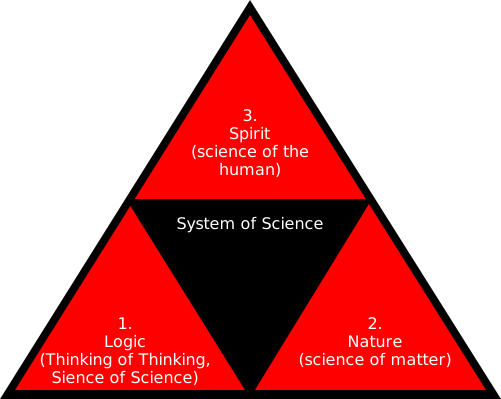
The systematic question is: can anthropocentrism be overcome without falling into anti-humanism? Hegel offers a mediation here. In the Logic, he develops the “Idea of Life” as a structure that contains purposiveness without an external purpose-setter. Life is an end in itself — it strives for self-preservation and self-development without anyone needing to “set” this purpose. This holds for all life, not only human life.
But the human being differs from other life in being able to relate reflexively to his own life. He can reflect upon and shape his relation to nature. This means: the human being is not merely one living being among others, but neither is he the “master” of nature. He is the living being who can and must take responsibility for his relation to nature.
The Threefold Mediation
Hegel’s philosophy offers the resources for a differentiated position. The human being stands in a threefold relation to nature.
First, he is nature: body, needs, drives. The human being is an animal, an organism, embedded in ecological cycles. This first nature cannot be overcome, only shaped.
Second, he shapes nature: culture, technology, institutions. The human being transforms his environment, adapts it to his needs, creates a “second nature” of social forms. This is not illegitimate — it belongs to being human to shape one’s world.
Third, he reflects on his relation to nature: philosophy, ethics, ecology. The human being can make his own shaping of nature an object of reflection and ask: Is it sustainable? Is it just? Does it respect the intrinsic value of the living?
The ethical consequence is: sustainable mediation. Not domination over nature (the modern ideal), but also not oneness with nature (the romantic ideal). Rather, respectful shaping in awareness of limits. The human being may use nature — but in such a way that the foundations of life are preserved. He may shape it — but in such a way that other life forms are not destroyed.