The Neo-Scholastic Starting Point: Recapitulation and Transition
This text is a preview of History of the Reception of Hegel, volume II, to be published in 2026 by Reflexivity Press.
Looking Back at Volume 1: The Decisions Made Before 1945
Catholic reception of Hegel began with rejection. Already in the nineteenth century Hegel counted as the main enemy: his alleged “pantheism” (God and world supposedly coincided), his “rationalism” (reason supposedly grasped everything, even God), his “historicism” (even truth supposedly develops). All of this was regarded by Thomistic orthodoxy as incompatible with Christian doctrine.
The encyclical “Aeterni Patris” (1879) made Thomas Aquinas the standard of Catholic philosophy. This was also directed against Hegel – or more precisely: against what one took Hegel to be.
But even early on there were attempts at mediation. Joseph Maréchal (1878-1944), a Belgian Jesuit, developed “transcendental Thomism”: reading Thomas in light of Kant. The question is no longer “What is being?” but “What are the conditions of the possibility of knowledge?” Maréchal showed: Thomas’s epistemology implicitly contains a transcendental structure – the mind’s striving toward the infinite as the condition of any finite cognition.
This was not yet Hegel – but it opened the door. If one can read Thomas “transcendentally,” can one perhaps also bring him into conversation with Hegel?
Methodological Preliminary Remark: Readings of Hegel and Their Relevance
In Chapter 7a we distinguished various lines of interpretation. This distinction is also decisive for the Catholic reception of Hegel:
The “metaphysical” reading (Taylor) understands Hegel as a cosmic ontologist: God is Spirit, the Idea really externalizes itself. This reading takes Hegel’s formulations at their word.
The “anti-metaphysical” readings (Pippin, Pinkard, Brandom) read Hegel as a post-Kantian: the Logic explicates the conditions of rational norm-giving, “Spirit” is social practice. But these readings may reduce Hegel’s ontological dimension.
The “anti-mystical” readings (Stekeler, and related to it, our own) strive for complete traceability, without reducing Hegel to normativity or sociology. Stekeler translates “God” as “the instance of absolute truth,” “Spirit” as the “We-subject” of rational practice. Our reading shares the concern for traceability but holds the question of God more open: the “thoughts of God before creation” are the pure logical structures – systematically more fundamental, not temporally earlier. But whether these structures are thought by a personal God, or are themselves the Absolute, remains argumentatively open. The Logic is compatible with both theistic and atheistic worldviews, but compels neither.
The debate “metaphysical vs. anti-metaphysical” may miss the point. The key is simpler: the supposed “comparison” between mind and world does not actually take place. Everything happens within consciousness – but there are moments within it that resist our arbitrary will. These resistances point the way toward objectivity. Thought does not disclose the world by producing it – it discloses the world by encountering resistance. “Inside” and “outside” are not separate worlds, but distinctions within experience. This is Hegel’s unity of thought and being: not asserted mystically, but experienced in the very pursuit of truth.
Important for what follows: the Neo-Scholastic charges – pantheism, rationalism, historicism – hit none of these serious readings of Hegel. They hit a caricature. This is what needs to be shown.
The Neo-Scholastic Charges Against Hegel – And What Is Right About Them
The Neo-Scholastics formulated three main charges against Hegel. These charges deserve fair examination – not in order to “defend” Hegel, but to understand what he actually says, and where the real differences lie.
First charge: “Pantheism” – Hegel allegedly identifies God and world; on his view there is supposedly no transcendent God.
What does Hegel himself say? In the famous passage from the introduction to the Science of Logic he writes that Logic is “the realm of pure thought,” “truth as it is in itself and for itself without veil.” And then, with a telling caution: “It can therefore be said that this content is the exhibition of God as he is in his eternal essence before the creation of nature and of a finite spirit.”
Hegel does not say: “This is God.” He says: “One can express it this way.” The Logic shows the pure structures of thought – that which we cannot think away without already presupposing it. In this sense the “thoughts of God before creation” are the logical structures themselves – not temporally earlier, but systematically more fundamental.
But Hegel does not stop at the Logic. In the Lectures on the Philosophy of Religion he goes further: “God as Spirit is essentially this self-revealing; he does not even create the world once, but is the eternal creator, this eternal self-revealing, this act.” Here God is not static substance, but living process – Spirit, which reveals itself in the world and in finite spirit.
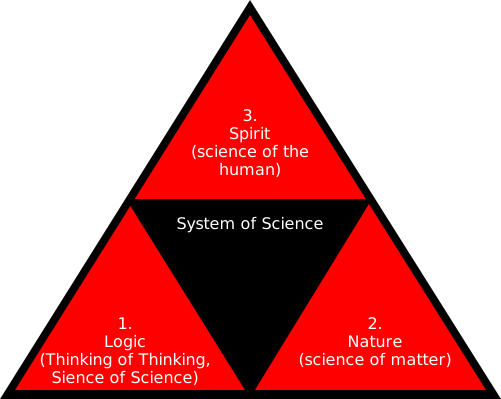
Is this pantheism? The answer depends on what one understands by “pantheism.” If pantheism means “God and world are simply identical,” then Hegel is no pantheist. He expressly distinguishes between the logical Idea (God “before” creation), nature (the externalization of the Idea), and Spirit (the return to self). The world is not God – it is God’s “other,” in which God reveals himself.
If pantheism means “there is no God beyond the world,” the question becomes more complex. Hegel does not claim that God exists “only” in the world. He claims that the question “Does God exist independently of the world?” is itself a question we pose in thought – and thereby we are already in the process in which Spirit manifests itself. This is not pantheism, but a different way of thinking the relation between God and world.
The Neo-Scholastics were thus right that in Hegel the question of God’s transcendence is posed differently than in Thomas. But they were mistaken in thinking that Hegel had decided this question negatively. Hegel does not say: “There is no transcendent God.” He says: the question of transcendence cannot be answered from a standpoint “outside” thought – for no such standpoint exists.
The anti-mystical readings show further possibilities: Stekeler understands “God” as the name for the fundamental order that we cannot think away. Our reading holds the question even more open: the Logic shows the pure structures – whether these are thought by a personal God remains argumentatively open. The Logic is compatible with theism and atheism, but compels neither. The fundamental is always greater than all our concepts, richer than all our methods, deeper than all our systems.
What is decisive: none of these serious readings – neither the metaphysical, nor the anti-metaphysical, nor the anti-mystical – corresponds to the caricature that the Neo-Scholastics criticized. Later Catholic thinkers – Przywara, Rahner, Balthasar – understood this.
Second charge: “Rationalism” – In Hegel, reason allegedly grasps everything, even God; there are supposedly no more mysteries.
This charge, too, hits a caricature. Hegel does not claim that we can know everything. He claims that what we know moves within certain structures – the structures of the Logic. He calls these structures “God’s thoughts before creation” – but this does not mean that we grasp God’s thoughts completely.
The absolute Idea is not “omniscience,” but the self-reflection of method – thought becoming transparent to itself. And this remains an unending process. Hegel himself emphasizes in the Logic: it is “still only the abstract Idea” – full reality shows itself only in nature and spirit, and even there not as a finished possession, but as living enactment.
The Neo-Scholastics feared that Hegel made the mystery of God the object of rational penetration. But Hegel’s “reason” is not the calculating understanding that dissects everything. It is the capacity to grasp connections that remain hidden to mere understanding. Hegel expressly distinguishes between “understanding” (which thinks in fixed categories) and “reason” (which grasps the movement of the concept).
What remains is a legitimate difference: for Thomas there are truths accessible only through revelation, which surpass reason. For Hegel there is no truth in principle inaccessible to reason – but this does not mean that we already possess it. The difference does not lie in whether there are mysteries, but in how we think the relation between reason and mystery.
Third charge: “Historicism” – In Hegel, even truth is supposedly historical; there are supposedly no eternal truths.
This opposition is skewed. Even Thomas knows that we human beings do not grasp truth by nature – otherwise he would not have taught and written books. For Thomas too, our access to truth is a process: through revelation, through teaching, through reflection.
The real question is: what is truth for us? Hegel’s answer: for us, truth is always a process of truth – a living enactment in which we test, judge, correct. We cannot stand “outside” this process and from there contemplate an “eternal truth.” The question “Is this true?” is itself already the search for truth – and thereby we are already in the process.
The logical structures that Hegel develops are not arbitrary or historically contingent. They are unavoidable – whoever denies them already enacts them. In this sense they are “eternal,” but not as static objects that exist somewhere, but as structures that necessarily show themselves in thought.
This differs less from Thomas’s position than the Neo-Scholastics thought. The real difference lies not in the question of whether truth is “eternal” or “historical,” but in the question of the relation between reason and revelation – and here too the difference is subtler than the polemic suggests.
Balance: What Remains of the Charges?
The three charges – pantheism, rationalism, historicism – do not hit Hegel’s actual position, but a caricature. They arose in a time when Hegel counted as an enemy of faith and when a fair examination of his arguments seemed impossible.
This does not mean that there are no legitimate differences between Hegel and the Catholic tradition. There are – but they lie deeper:
- Not: “Hegel denies the transcendence of God” – but: Hegel thinks transcendence differently than Thomas.
- Not: “Hegel makes God an object of the understanding” – but: Hegel thinks the relation of reason and mystery differently.
- Not: “Hegel relativizes truth” – but: Hegel thinks truth as process, not as static possession.
These differences deserve a genuine conversation – not polemic. The Second Vatican Council created the conditions for such a conversation. The thinkers we treat below – Przywara, Rahner, Balthasar, Lonergan – began it.
Vatican II as a Turning Point: From Defense to Openness
The Second Vatican Council (1962-1965) changed everything. The Church declared: we are not against modernity, but within it. We are not against other religions, but in dialogue with them.
Philosophically this meant: Thomism lost its monopoly. “Gaudium et Spes” (1965) spoke of “the signs of the times” that needed to be interpreted – an almost Hegelian formulation. The Church acknowledged: there is truth outside the Church as well, in modernity too, in other traditions too.
This was no capitulation to Hegel – but it was an opening that made a more differentiated engagement possible.
—