The systematic diagnosis: What Adorno misses in Hegel
This text is a preview of History of the Reception of Hegel, volume II, to be published in 2026 by Reflexivity Press.
First failure: The confusion of dialectics with teleology
Adorno attributes to Hegel the view that dialectics is teleological — that it necessarily leads to a positive result, that it harmonizes contradictions, that it reconciles opposites in a higher unity that erases all negativity. “Negation of the negation,” on this view, is the figure by which dialectics secures itself a happy ending.
This attribution is influential in the history of philosophy, but it is untenable as a matter of fact. Hegel’s dialectics is not teleological in the sense that a predetermined result guides the movement. The movement follows from the contradiction of the respective determination, not from a telos imposed on it from outside. The “absolute idea” — which appears in Adorno as a totalitarian closure — is, for Hegel, the method that has become transparent to itself: not an end result, but the structure of self-reflective rationality realizing itself in finite subjects. It is not an answer to all questions but the form in which questions can be posed.
Hegel himself explicitly criticized the confusion of dialectics with teleology. The “triplicity” — thesis, antithesis, synthesis — is a schema that goes back to Fichte and that Hegel rejects as an external “formalism.” The assumption that Hegel thinks in three-step sequences that automatically lead to reconciliation testifies to an unfamiliarity with the logical texts that is surprising in Adorno, who undoubtedly read Hegel.
Second failure: The confusion of identity with identification
As shown in the previous section, Adorno confuses Hegel’s concept of identity — the restoration of unity out of difference, which includes its distinction — with the understanding’s identifying, which erases difference. This confusion is not merely a philological error. It has systematic reasons: Adorno must read Hegel’s identity as violence, because only in this way can the Nietzschean-Heideggerian blockade appear as “critique of Hegel.” Were Adorno to acknowledge that Hegel’s identity includes difference, his central objection would collapse — then “identity of identity and non-identity” would not be suppression but exactly what Adorno himself seeks: a thinking that does justice to the non-identical.
Third failure: The confusion of system with totality
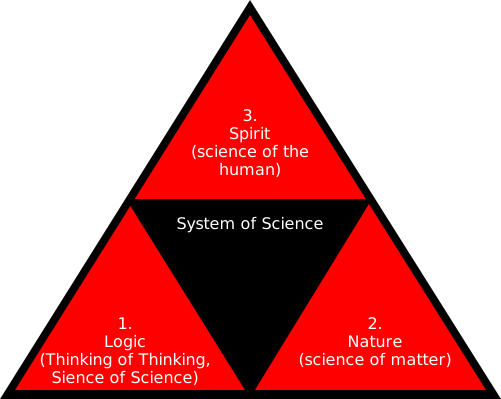
Adorno equates “system” with “totality” and both with “coercion.” The system includes everything, leaves nothing outside, subsumes everything under its categories. This image of a closed, gapless system that crushes everything is a phantasm that has little to do with Hegel’s actual concept of system.
Hegel’s system is “openly closed”: complete in its structures, but unfinished in its applications. Logic develops the universal forms of thought; but it does not dictate what actually happens in nature or in history. Logic does not establish that something is, but explicates the structures by which existing things can be understood. The contingency of existence, the openness of history, the unpredictability of the individual are not suppressed in Hegel’s system but systematically acknowledged — through the distinction between logic and real philosophy, through the acknowledgment of contingency in nature, through the openness of the philosophy of history toward the future.[1]
Adorno’s totalization of the “context of delusion” — the notion that everything is permeated and controlled by social totality — is, paradoxically, more total than anything Hegel ever claimed. Hegel’s system leaves room for contingency; Adorno’s “context of delusion” is gapless. Hegel’s dialectics acknowledges the independence of the individual; Adorno’s “negative ontology” makes the individual a mere victim of the universal. The irony is that Adorno accuses Hegel of a totality that he himself practices.
—
On the distinction between logic and real philosophy and on the systematic acknowledgment of contingency in Hegel’s system, see the interpretation underlying this work, chapters 9.12 and 23.5. ↩︎