The Ecological Turn – *Silent Spring* and *The Limits to Growth*
This text is a preview of History of the Reception of Hegel, volume II, to be published in 2026 by Reflexivity Press.
The End of Progress Optimism
Rachel Carson’s Silent Spring (1962) shows: pesticides (DDT) kill not only pests but entire ecosystems. The “silent spring”—no birds singing anymore because they have been poisoned—becomes a metaphor for the self-destruction of industrial civilization.[1]
The Club of Rome publishes The Limits to Growth (1972, but work begins in 1968): computer models show that exponential economic growth on a finite planet is impossible. Collapse is mathematically calculable—unless a course correction is made.[2]
The philosophical consequence: Hegel’s philosophy of history—history as progress in the consciousness of freedom—is ecologically refuted. Not progress but self-destruction is the result. The “cunning of reason” turns out to be the cunning of unreason—capitalism produces its own downfall.
But: the ecology movement is not anti-rationalist (like Romanticism) but scientifically grounded. Carson is a biologist, the Club of Rome works with systems dynamics. This is dialectical: reason criticizes itself—it shows its own limits.
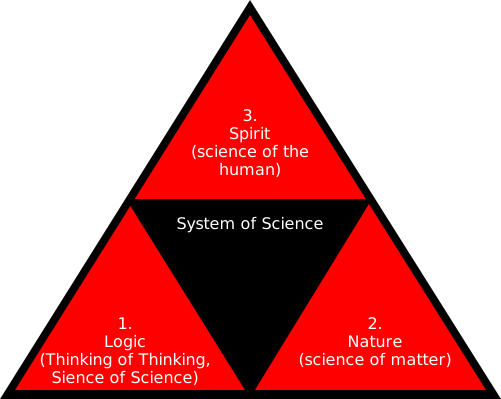
Hegel’s philosophy of nature is read anew: not as speculative construction but as an attempt to think nature as subject—not mere material, but an independent reality. This later (from the 1980s) becomes “ecological philosophy” (Hans Jonas, Klaus Michael Meyer-Abich).[3]
Rachel Carson: Silent Spring (1962). On its impact see Linda Lear: Rachel Carson: Witness for Nature (1997). ↩︎
Dennis Meadows et al.: The Limits to Growth (1972). On the debate see Ugo Bardi: The Limits to Growth Revisited (2011). ↩︎
Hans Jonas: The Imperative of Responsibility (1979); Klaus Michael Meyer-Abich: Aufstand für die Natur (1990). ↩︎