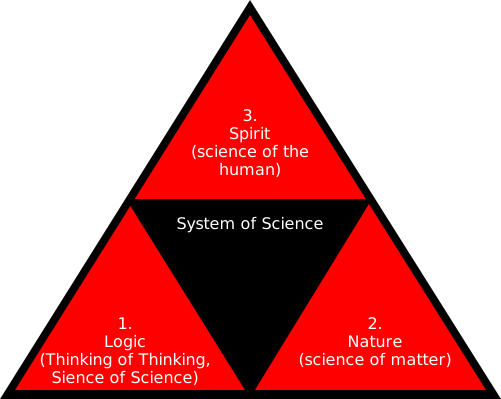
Commentary on the Logic, Chapter 11
The Syllogism as Justification
The judgment says “S is P.” Doubt asks “Why?”. The answer must display the mediation: “S is M, and M is P, therefore S is P.” The middle term (M) is the “because” — the bridge that connects the particular to the universal. Without the syllogism, everything remains mere opinion. Science is the system of syllogisms.
The Threefold Permutation — Hegel’s Brilliant Move
Summary tables of the syllogistic forms:
Syllogisms of Existence — the middle term is chosen arbitrarily:
| Figure | Schema | Example | Problem |
|---|---|---|---|
| 1st Figure | I-P-U | “The rose is red / Red is a color / The rose is colored” | Arbitrary middle term |
| 2nd Figure | P-I-U | “Some things are useful / Tools are things / Some tools are useful” | No necessity |
| 3rd Figure | I-U-P | “Humans are mortal / Stones are not mortal / A human is not a stone” | Only separates, does not connect |
The shared problem: the middle term is chosen arbitrarily — one could just as well have picked another. The syllogism “holds” formally, but it explains nothing. We need a middle term that is not arbitrary but captures the entire scope of the matter.
Syllogisms of Reflection — universality remains problematic:
| Form | Example | Failure |
|---|---|---|
| Totality | “All humans are mortal / Caius is human / Caius is mortal” | Circular — “all” presupposes Caius |
| Induction | “Gold conducts, copper conducts… / All metals conduct” | Never completable |
| Analogy | “Earth has life / The moon resembles the earth / Does the moon have life?” | Similarity is vague |
Both forms of syllogism are unavoidable, and both are uncertain — this is not a defect of logic but the condition of any cognition that reaches beyond what is given. How to deal with this uncertainty in practice is developed in [[wahrheit:10]] (optional) as calibration.
One step further: syllogisms of reflection reach beyond the individual case — but they never arrive at necessity. Induction collects cases without ever having seen all of them. Analogy points to similarity without knowing its ground. The deficiency: we need insight into the real ground of the matter, not mere generalization.
Syllogisms of Necessity — the middle term shows the real ground:
| Form | Example | Cognitive Gain |
|---|---|---|
| Categorical | “Gold is a metal / Metals conduct / Gold conducts” | Shows why — from the nature of the genus |
| Hypothetical | “If friction, then heat / Here there is friction / Therefore heat” | Conditional necessity |
| Disjunctive | “Metal is Fe or Cu or Au… / Not Fe, not Cu / Therefore Au” | Process of elimination |
Here the circle closes: the middle term is no longer arbitrary but shows the inner necessity of the connection. “Gold conducts because it is a metal” — the why lies within the what.
Every element (I, P, U) must occupy the middle position once!
| Figure | Structure | Example | Type |
|---|---|---|---|
| Figure 1 (I-P-U) | The particular mediates | “Socrates (I) is mortal (U), because he is human (P)” | Deduction |
| Figure 2 (U-I-P) | The individual mediates | “Gold, copper, iron (I) conduct -> all metals (U) conduct” | Induction |
| Figure 3 (P-U-I) | The universal mediates | “The organism (P) preserves itself through natural law (U) in this living being (I)” | Analogy |
Only the circulation through all three figures makes reason complete. A theory (U) must prove itself in experiments (I) and be mediated through methods (P). Only when the circle U-P-I-U is closed is a system stable.
From the Syllogism of Existence to the Syllogism of Necessity — The Inner Movement
Here too, each stage is driven to the next by its own deficiency:
Syllogisms of Existence (≈ the logic of being within the syllogism): The qualitative syllogisms (Figures 1–3) rest on contingent properties. “The rose is red; everything red is beautiful; therefore the rose is beautiful” — formally correct, but the middle term “red” is arbitrary: one could just as well have chosen “thorny” and arrived at the opposite conclusion. The deficiency: The middle term is too impoverished — it picks out an arbitrary feature. The transition: We need a middle term that is not arbitrary but that grasps a whole extension.
Syllogisms of Reflection (≈ the logic of essence within the syllogism): Induction and analogy reach beyond the single case. Induction: “This swan is white, that one too… therefore all are.” Analogy: “The Earth has an atmosphere and life; Mars has an atmosphere; therefore Mars perhaps has life.” Both yield probability, but no certainty. The deficiency of induction: The “syllogism of allness” has a circularity problem — it presupposes that we have observed all cases, but that is precisely what we can never know. Induction is a bad infinity of inference: always one more case to check. The transition: What we need is not an enumeration of all cases, but insight into inner necessity.
Syllogisms of Necessity (≈ the logic of the concept within the syllogism): Categorical: “Gold is a metal; metals conduct; therefore gold conducts” — the connection is essential, not accidental. Hypothetical: “If temperature > 100°C, then water evaporates” — the condition necessitates the consequence. Disjunctive: “This metal is either gold, silver, copper… (the disjunction is complete). This metal is not gold, not silver… Therefore it is copper.” Here the necessity is compelling because all alternatives are excluded. The disjunctive syllogism is the highest form because it exhausts the totality of possibilities.
The parallel to the overall architecture: The three stages of the syllogism repeat the three parts of the Logic: being (immediate, contingent) → essence (reflected, probable) → concept (comprehending, necessary). Here too, the spiral staircase turns.
The Syllogism as Science — Definition, Division, Proof
What appears here as the task of science was once standard material of classical logic and has largely disappeared today — set theory knows no determination of order, formal logic begins with ready-made concepts. [[systematisches-denken:6a]] (optional) describes this gap, [[systematisches-denken:8]] (optional) develops the doctrine of division anew. Science is systematic inference. Three moments of scientific practice correspond to the three forms of the syllogism: Definition (What is it? — categorical), Division (Which kinds? — disjunctive), Proof (Why is it so? — hypothetical). The logic of the syllogism is not mere formalism — it is the grammar of scientific argumentation.
Hegel vs. Formal Logic
Formal logic treats inferences as purely syntactic operations — whether the premises are true is of no interest to it. Hegel’s logic shows: the form of the inference itself has a content. The inference of existence is content-poor (tautological); the inference of necessity is content-rich (it grasps the essence). The form develops — and with it, what can count as a “proof.” Formal logic stands to Hegelian logic as a chessboard stands to a game of chess: the rules are necessary, but the game goes beyond them.