Commentary on the Logic, Chapter 14
The Syllogism as Grounding
At the end of the series of judgments, “subject and predicate […] are in this way each themselves the whole judgment” (Encyclopedia, vol. 1, §180). With this the copula is no longer empty: what the is expresses is the unity of both, and this unity is distinguished from what it connects. Hegel draws the conclusion: the concept is “the fulfillment of the empty is, the copula,” and insofar as its moments are distinguished as subject and predicate, it is “posited as the relation mediating them — the syllogism.”
Practically speaking, this is the question of why, but it does not come to the judgment from outside: the apodictic judgment already contains its ground, and the syllogism only makes it explicit. “S is M, and M is P, therefore S is P” — the middle term (M) is the because. The middle term is the bridge connecting the individual with the universal. Hegel puts this pointedly: science is a system of syllogisms. The claim holds for what it aims at — that a knowledge unable to state its mediations remains mere opinion. It does not hold in the sense that one could obtain science by drawing syllogisms: the work consists in finding the middle term, and for this the theory of the syllogism provides no procedure. [KF]
The Threefold Permutation — Each Moment as Middle Term
Summary tables of the forms of the syllogism:
Here, too, the terms have been given a German name: Hegel writes Schluß des Daseins (syllogism of determinate being), Schluß der Reflexion (syllogism of reflection), and Schluß der Notwendigkeit (syllogism of necessity) (Encyclopedia Vol. 1, §§ 183–192).
Syllogisms of determinate being — the middle term is chosen arbitrarily:
| Figure | Schema | Example | Problem |
|---|---|---|---|
| 1st Figure | I-P-U | “A rose is red / Red is a color / A rose is colored” | Arbitrary middle term |
| 2nd Figure | P-I-U | “Some things are useful / Tools are things / Some tools are useful” | No necessity |
| 3rd Figure | I-U-P | “Humans are mortal / Stones are not mortal / A human is not a stone” | Only separates, does not connect |
The shared problem: the middle term is chosen arbitrarily — one could just as well have taken a different one. The syllogism holds formally, but it explains nothing. We need a middle term that is not accidental but grasps the whole scope of the matter.
Syllogisms of reflection — universality remains problematic:
| Form | Example | Failure |
|---|---|---|
| Allness | “All humans are mortal / Caius is a human / Caius is mortal” | Circular — “all” already presupposes Caius |
| Induction | “Gold conducts, copper conducts… / All metals conduct” | Can never be completed |
| Analogy | “The earth has life / The moon is earth-like / Does the moon have life?” | Similarity is vague |
Both forms of syllogism are unavoidable, and both are uncertain — this is not a defect of logic but the condition of any cognition that goes beyond what is given. How to deal with this uncertainty in practice is developed by Die Wahrheit über Wahrheit, Kapitel 10 as calibration.
One step further: syllogisms of reflection reach beyond the individual case — but they do not arrive at necessity. Induction collects cases without ever having seen all of them. Analogy points to similarity without knowing its ground. The deficiency: we need insight into the objective ground of the matter, not mere generalization.
Syllogisms of necessity — the middle term shows the objective ground:
| Form | Example | Cognitive gain |
|---|---|---|
| Categorical | “Gold is a metal / Metals conduct / Gold conducts” | Shows why — from the nature of the kind |
| Hypothetical | “If friction, then heat / Here, friction / Therefore, heat” | Conditional necessity |
| Disjunctive | “A metal is Fe or Cu or Au… / Not Fe, not Cu / Therefore Au” | Process of elimination |
Here the circle closes: the middle term is no longer arbitrary but shows the inner necessity of the connection. “Gold conducts because it is a metal” — the why is contained in the what.
Each element (I, P, U) must at some point occupy the middle position!
| Figure | Structure | Example | Type |
|---|---|---|---|
| Figure 1 (I-P-U) | The particular mediates | “Socrates (I) is mortal (U), because he is human (P)” | Deduction |
| Figure 2 (U-I-P) | The individual mediates | “Gold, copper, iron (I) conduct -> all metals (U) conduct” | Induction |
| Figure 3 (P-U-I) | The universal mediates | “The organism (P) sustains itself through a law of nature (U) in this living being (I)” | Analogy |
Only the circuit of all three figures makes reason complete. A theory (U) must prove itself in experiments (I) and be mediated by methods (P). Only when the circle U-P-I-U is closed is a system stable.
From the Syllogism of Determinate Being to the Syllogism of Necessity — The Inner Movement
Here too, each stage is driven to the next by its own deficiency:
Syllogisms of Determinate Being (≈ the logic of being within the syllogism): The qualitative syllogisms (Figures 1–3) rest on contingent properties. “The rose is red; everything red is beautiful; therefore the rose is beautiful” — formally correct, but the middle term red is arbitrary: one could just as well have chosen thorny and arrived at the opposite conclusion. The deficiency: the middle term is too poor — it picks out an arbitrary feature.
Hegel names a second deficiency, one that lies deeper and becomes visible only when we consider the three figures together. In the first figure, E–B–A, both premises are themselves unmediated — they are simply presupposed. One is mediated in the third figure, the other in the second. “But each of these two figures likewise presupposes its two other figures for the mediation of its premises” (Encyclopedia, vol. 1, § 189). The three figures ground one another in a circle — Hegel calls it “a circle of mutually presupposing mediations.”
Not an objection to the permutation but its result: it shows that none of the figures stands on its own. But it shows this negatively — as a circle, not as a unity. The transition: what is needed is a middle term that is not borrowed from the other figures but itself grasps a whole scope.
Julie Maybee draws attention here to a repetition that illuminates the construction of the entire work. At the end of the qualitative syllogism, each of the three moments has occupied every position and has thereby taken on the character of the other two. The consequence: they all now have the same character and can no longer be distinguished qualitatively — only quantitatively. This is exactly the situation that arose at the end of the Doctrine of Quality, when quality could no longer distinguish the elements and only multiplicity remained.[1]
This is why the quantitative or mathematical syllogism follows — the same step as in Chapter 1, at a different stage. Anyone who has read the logic of being recognizes the figure again and need not learn it anew.
And the positive result of this same movement: each moment now has a richer character than before — it is determined by the other two. The syllogism of reflection works out this gain.
Syllogisms of Reflection (≈ the logic of essence within the syllogism): Induction and analogy reach beyond the singular. Induction: “This swan is white, that one too… therefore all.” Analogy: “The Earth has an atmosphere and life; Mars has an atmosphere; therefore Mars perhaps has life.” Both yield probability, but no certainty. The deficiency of induction: the syllogism of allness has a circularity problem — it presupposes that we have observed all cases, but that is precisely what we can never know. Hegel formulates it exactly this way: the major premise, which has allness as its subject, “rather itself presupposes the conclusion which it was supposed to have as its precondition” (§ 190). And because the empirical singular is distinct from universality and “can therefore afford no completeness,” induction gives way to analogy — which achieves even less. Induction is a bad infinity of inference: always one more case. In the case of analogy, the deficiency can be grasped through an example Hegel himself uses: the Earth is an orbiting body and is inhabited; Mars is an orbiting body; therefore it is perhaps inhabited. The inference fails because the connection between being an orbiting body and being inhabited is an immediate one — that the Earth is inhabited is simply found to be the case, not derivable from its orbiting. Were the property one that follows from the genus — being in motion, say — then the inference would hold.[2]
The transition: what is sought, then, is not the enumeration of all cases, but a connection that is necessary.
Syllogisms of Necessity (≈ the logic of the concept within the syllogism): Categorical: “Gold is a metal; metals conduct; therefore gold conducts” — the connection is essential, not contingent. Hypothetical: “If temperature > 100°C, then water evaporates” — the condition compels the consequence. Disjunctive: “The metal is either gold, silver, copper… (the disjunction is complete). This metal is not gold, not silver… Therefore it is copper.” Here the necessity is compelling because all alternatives are excluded. The disjunctive syllogism is the highest form because it exhausts the totality of possibilities.
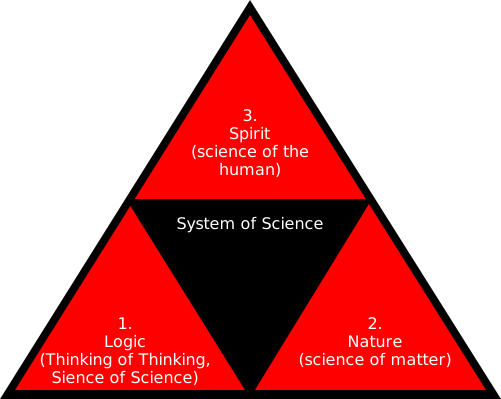
The parallel to the overall architecture: the three stages of the syllogism repeat the three parts of the Logic: Being (immediate, contingent) → Essence (reflected, probable) → Concept (comprehending, necessary). The spiral staircase turns here as well.
Inference as Science — Definition, Division, Proof
What appears here as the task of science was once curriculum material of classical logic and has today largely disappeared — set theory knows no determination of order, formal logic begins with ready-made concepts. Systematisches Denken, 6a describes this gap, Systematisches Denken, Kapitel 8 develops the doctrine of division anew.
Science is systematic inference. Three moments of scientific practice correspond to the three forms of inference: Definition (What is it? — categorical), Division (Which kinds? — disjunctive), Proof (Why is it so? — hypothetical). The logic of inference is thus more than a calculus: it names which kind of question is being answered in each case. What it does not accomplish is the answer itself — which definition is correct, which division articulates the matter, which ground truly carries it, no form can say. [KF]
The Limit of Permutation — Why It Delivers Less Than It Promises
That each moment can once serve as the middle term sounds like a tool. One can use it to cast social relations into three figures: the citizens who build the economy, and the economy the state; the state, which makes use of the citizens to build the economy; the economy, which makes use of the state to lay claim to individuals. The third figure looks like a diagnosis of inversion.
It is not one. The work is done before the figures begin, and it is not shown.
First, the choice of terms. Why citizens, economy, and state? Why not family, civil society, and state — Hegel’s own triad? Why not needs, production, and distribution? Each of these divisions yields different figures, and all are equally correct in form. Whoever chooses the terms has already done the analysis — or missed it.
Second, the place of mediation. That in a given society the economy does the mediating and not the state is a substantial claim. The figure presents this claim; it does not ground it.
Here it is as it is in formal logic: the real work lies in finding the concepts and seeing how the propositions hang together. That one can then link them with and and or is not the problem. Whoever hopes to gain knowledge from permutations mistakes the notation for the matter itself. [KF]
What carries the weight instead: teleology. The means-end connection delivers what the syllogistic figures promise, and it delivers it because it has a standard: a means can be measured by whether it is fit for the end.
Wage labor shows what follows from this. The wage laborer is separated from the means by which he could satisfy his needs: the goods belong to others, and so do the means of producing them. To gain access to them, he must perform wage labor and receive a wage, with which he buys them.
But in this labor he pursues the ends of others — and in doing so produces precisely the goods to which he gains access only through the wage. The means by which he satisfies his need is thus the very thing that maintains the separation that refers him to this means in the first place. It reproduces its own precondition.
The claim concerns the matter itself, not a form of presentation. It can be disputed, tested, and refuted — which cannot be said of a syllogistic figure. [KF]
Hegel and Formal Logic
Anyone who has learned truth tables, studied predicate logic, or formalized proofs in a proof assistant is right to ask: Did Frege not show that Aristotelian syllogistics is inadequate? Why should anyone still bother with figures of the syllogism today?
The objection is justified — and the answer runs through a point at which formal logic deliberately leaves something out. Material implication is defined so that “A → B” is false only when A is true and B is false. From this it follows that “If 2+2=5, then I am the Pope” is true, because the antecedent is false. “If the moon is made of cheese, then it is raining” is true. These inferences are formally valid and say nothing about a relation between antecedent and consequent — precisely what we expect from if, then has been eliminated.
This is not a defect but the price of a decision that has good reasons behind it: material implication is meant to preserve truth, not to represent ordinary if, then. Whitehead and Russell discuss the “paradoxes of material implication” at length in the Principia Mathematica and justify them pragmatically: material implication is unambiguously defined, mechanically evaluable, and context-free. The price is that it abstracts from substantive connection.
This is exactly where Hegel’s doctrine of the syllogism begins. The question of the three forms of the syllogism is not whether an inference is formally correct, but whether the middle term captures the matter at hand. “The rose is red; everything red is beautiful; therefore the rose is beautiful” is formally impeccable and substantively worthless, because red has been chosen arbitrarily. The development from the syllogism of determinate being to the syllogism of necessity is the development of what qualifies as a middle term.
Modern logic has rediscovered this question. In the 1960s and 70s, Alan Ross Anderson and Nuel Belnap developed relevance logic, which formalizes exactly this: an implication should hold only if antecedent and consequent are substantively connected — concretely, if they share at least one non-logical term (variable sharing). “If the moon is made of cheese, then snow is white” is not valid in relevance logic, because no shared term occurs. This also does away with ex falso quodlibet — from a falsehood, not just anything follows.
A reception of Hegel this is not; Anderson and Belnap came to it from different questions. But it shows that the distinction Hegel develops through the forms of the syllogism is no idiosyncrasy of speculation. It reappears as soon as one tries to formally capture the if, then of ordinary speech.
How the two relate to each other. Not as competitors, since they answer different questions. Formal logic examines whether one statement follows from given statements; for this it is unsurpassed and indispensable in mathematics, computer science, and verification. Hegel’s logic asks how concepts arise, what a middle term must prove itself against, and how forms of justification develop.
More precisely: formal logic is a calculus of valid transformations, Hegel’s logic a theory of conceptual forms of justification and mediation. The one asks whether a statement follows from given premises; the other, what the substantive ground is by which these determinations belong together. Both are necessary; neither replaces the other. [KF]
The practical conclusion: formal logic, if you want to check arguments. Hegel’s logic, if you want to develop concepts. Both, if you want to think well.
And a limit to the comparison. Hegel himself did not know the formal logic meant here — Frege was born twenty years after Hegel’s death. What he criticizes is the school logic of his own time, and some of his objections therefore miss what goes by that name today. To pit him against Frege is to make him contend with something he never knew. [KF]
Maybee, Picturing Hegel, on the quantitative syllogism: “This logical situation is similar to the one that was developed at the end of the Doctrine of Quality, in which quality could no longer distinguish the logical elements in play.” ↩︎
Maybee, Picturing Hegel, on the syllogism of necessity: “The connection between the earth as an orbiting body and its being inhabited is simply an immediate one.” ↩︎