God
Hegel (absolute idea, religious language for a philosophical concept)
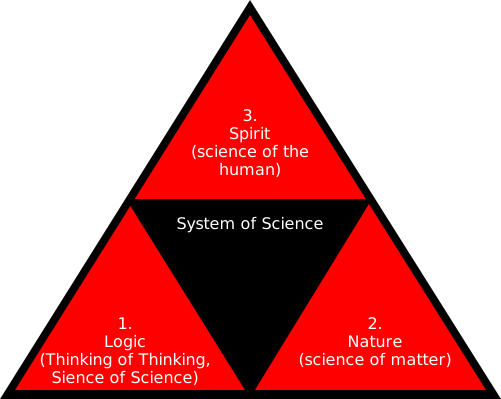
For Hegel, God is not the personal being of religion but the fundamental order — the absolute idea that unfolds itself in logic, nature, and spirit. The *Logic* shows "God as he is in his eternal essence before the creation of nature" — demystified: the structures of thought that underlie everything. Hegel renders the question of God scientifically tractable, without dogmatic prior decisions (neither theistic nor atheistic). The absolute idea is the Absolute that knows itself. Whether this order is personal remains philosophically open — the *Logic* shows only the rational structures. Hegel's "theodicy" is a justification of rationality itself: reality is knowable. Practically speaking, religion and science both seek the fundamental — only in different form. Hegel makes possible a conversation at a higher level of reflection.
Origin
Theologia naturalis (natural knowledge of God). Spinoza: Deus sive Natura (God or Nature). Kant: God as postulate. Hegel: God as absolute idea — rationally comprehensible, but not dogmatically fixed. Difference from religion: philosophy treats God conceptually, religion in representation (*Vorstellung*).
In Hegel
Enc. §194 (Addition), §236 (Addition); *Science of Logic*, vol. 1, Preface
Im buch
Ch. 23.7