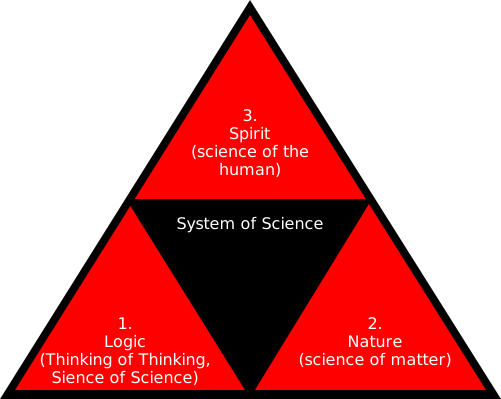
Three Dimensions (of Systematic Thinking)
Froeb (Denkenbuch)
The three universal dimensions of systematic thinking: (1) Classification – ordering things by type, (2) Articulation – dividing structures into parts and wholes, (3) Relation – recognizing connections between elements. Each dimension is indispensable: without classification there is no order, without articulation no structure, without relation no connections. Only their integration makes complete systematic thinking possible.
In Hegel
There is no direct correspondence, but the three groups of judgments (quality/quantity, reflection/relation, concept/modality) show a similar structure of differentiation.
Cross-references
Urteil · Klassifikation · Gliederung · Beziehung · Denkenbuch
Im buch
Ch. 10, 11, 13
Praktische bedeutung
If you want to understand a complex subject, you must apply all three dimensions: - What kinds are there? (Classification) - How is it structured? (Articulation) - How does everything connect? (Relation)
Systematischer ort
The three dimensions correspond to Hegel's three forms of judgment: - Classification – judgments of quality and quantity ("This is an X," "This has property Y") - Articulation – judgments of reflection/relation ("This belongs to that," "This stands in this relationship") - Relation – judgments of the concept/modality ("This is necessary/possible," "This is the concept of that") The integration of all three dimensions corresponds to the syllogism and the system of syllogisms.