Skip to content
hegel.net

    Nothing found

    Search data could not be loaded

    • 🇩🇪 deutsch
    • 🇫🇷 français
    • 🇮🇹 italiano
    • 🇪🇸 español
    • 🇧🇷 português
    • 🇳🇱 hollands
    • 🇷🇺 русский
    • 🇨🇳 中国
    • 🇰🇷 한국의
    • 🇯🇵 日本の
    • 🇮🇳 हिन्दी
    • 🇸🇦 العربية
      • Overview
      • Logic
      • Nature
      • Subjective Spirit
      • Objective Spirit
      • Art
      • Religion
      • Philosophy
      • Quotations
      • Phenomenology
      • Texts online
      • All writings
      • Editions
      • Paragraph concordance
    • E-Texts
      • Articles
      • Topics
      • Commentary on the Logic
      • Commentary on the Philosophy of Nature
      • Commentary on Subjective Spirit
      • Commentary on the Philosophy of Right
      • Glossary
      • Hegel-Studien
      • The Owl of Minerva
      • Biography
      • Timeline
      • Contemporaries
      • Gallery
      • History of Hegel's reception I
      • History of Hegel's reception II
      • People
      • Hegelian PDFs
    • FAQ
      • Download posters
      • Buy posters
      • Audiobooks (German)
      • Quiz
      • What's new
      • Use and symbols
      • Ways of ordering
      • Kinds of cross-reference
      • About these pages
      • Links
      • Imprint
      • Terms of use
      • Privacy policy
      • E-mail
    • 🇩🇪 deutsch
    • 🇫🇷 français
    • 🇮🇹 italiano
    • 🇪🇸 español
    • 🇧🇷 português
    • 🇳🇱 hollands
    • 🇷🇺 русский
    • 🇨🇳 中国
    • 🇰🇷 한국의
    • 🇯🇵 日本の
    • 🇮🇳 हिन्दी
    • 🇸🇦 العربية

    23321

    Sensory Organs

    ?
    2.3.3.2.1. Sensory Organs © 2003-2026 hegel.net · Kai Froeb 2.3.3.2.1. Sensory Organs 2.3.3.2.1.1. Tactile Sense 2.3.3.2.1.2. Smell and taste 2.3.3.2.1.3. Eyes and Ears One level back to Appropriation of the outside world (assimilation) One level further to Tactile Sense One level further to Smell and taste One level further to Eyes and Ears
    2.3.3.2.1. Sensory Organs © 2003-2026 hegel.net · Kai Froeb 2.3.3.2.1. Sensory Organs One level back to Appropriation of the outside world (assimilation) One level further to Tactile Sense One level further to Smell and taste One level further to Eyes and Ears 2.3.3.2.1.1. Tactile Sense One level back to Tactile Sense 2.3.3.2.1.2. Smell and taste One level back to Smell and taste 2.3.3.2.1.3. Eyes and Ears One level back to Eyes and Ears
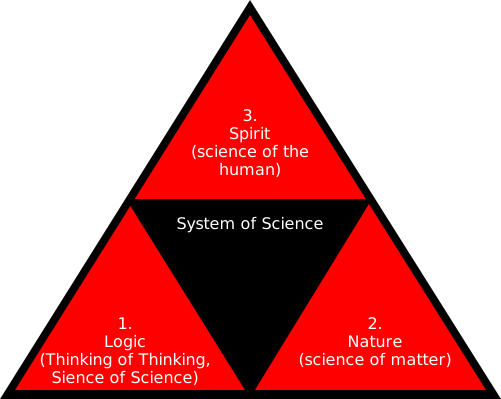
    • 0 Hegel's 'System of Science'
    • 1 Logic (Thinking of Thinking, Science of Science)
    • 2 Nature (science of matter)
    • 3 Spirit/Mind (Science of humanities)
    • 21 Mechanics
    • 22 Physics (including Chemistry)
    • 23 Organism / Life (Subjectivity)
    • 231 The Earth (Geology)
    • 232 Plant life (biology of the vegetal)
    • 233 Animal life (biology of the animal)
    • 2331 Shaping (metabolism)
    • 2332 Appropriation of the outside world (assimilation)
    • 2333 Genus process of the animals (reproduction)
    • 23321 Sensory Organs
    • 23322 Incorporation
    • 23323 Art impulse
    • 233211 Tactile Sense
    • 233212 Smell and taste
    • 233213 Eyes and Ears

    Texts online

    • HTM The Philosophy of Nature (Book 2 of the Encyclopedia) 1817

    Hegel texts on this topic

    • Enzyklopädie II, § 358🇩🇪 DE

    Commentary on this

    • What Remains of Physics
    • What the Organics Deals With
    • The Geological Organism
    • Plant and Animal

    See also

    • 311131 Senses ≡

    Sense Organs

    To the glossary index · ↑ Top of page

    The organs through which the animal knows the world — theoretical comportment, as distinct from the practical comportment of digestion.

    In Hegel: 23321

    Cross-references: Chap. 24

    Commentary on the Philosophy of Nature: I. What It Undertakes

    To the glossary index · ↑ Top of page

    ↑ Appropriation of the outside world (assimilation) Incorporation →

    Copyright for the triangle diagram, its labelling and the selection of links above this notice:
    © 2020–2026 by hegel.net, Kai Froeb. This content is licensed under CC BY-NC-SA 4.0.

    Copyright for the explanatory text below the triangle:
    © 2020–2026 by hegel.net, Kai Froeb. The explanatory text is licensed under the ZMC licence.

    Share

    Share

    ✉ Email 𝕏 X in LinkedIn f Facebook

    Imprint Terms of use Privacy policy