Benutzung und Zeichen
Since January 11, 2005, Hegel-System (German) and Hegel.net (international) have formed a joint site.
Explanation of how Hegel-System works:
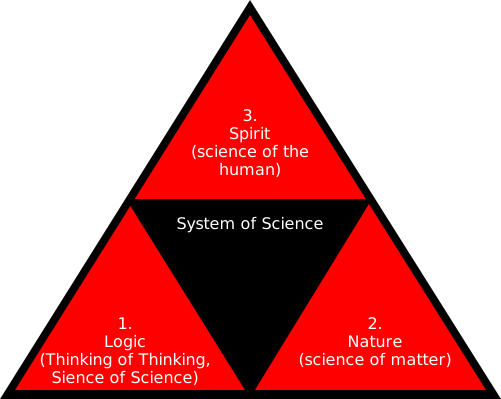
With the help of the large triangle you can move through the levels of Hegel’s Scientific Universal System:
- Click the center = jump up a level.
- Press the side triangles = go down a level.
The whole thing is a threefold branching tree, so repeatedly clicking the center always leads back to the start.
Eight colors mark the different levels. From the ninth level on, the colors repeat. Fields with question marks indicate extensions that we have made.
The center of the triangle is always the [current topic area].
If you select the [“Contributions”] function to the right of the triangle, you get to the [“Contributions overview”] matching the current topic, where all contributions, articles, discussions, etc., are listed. These can then be opened by clicking on them.
If there is no contribution yet on the current topic, you jump automatically to the next higher topic for which contributions are available.
The “Cross-entry” function (e.g. “New”, “for beginners” in the menu) offers alternative access to the same contributions.
(Tip: pressing “F11” on the keyboard switches to fullscreen size.)
We welcome comments, questions, articles, and the like from users! Please report any errors you encounter!!
Where the presentation comes from
Stefan Sy designed the shape of the triangle. The structure of Hegel’s system depicted in it comes for the most part from Martin Grimsmann and Lutz Hansen; Kai Froeb has supplemented it, translated it into the other languages, and implemented it technically.
This collaboration produced a poster of the first five levels, designed by Dietwald Doblies. It is still available today.
Why it is not a Sierpinski triangle. At first glance the figure looks like that well-known fractal: a triangle that divides into three smaller ones, and these again. A difference only becomes apparent on closer inspection — the three sub-triangles are enclosed by a frame that carries the color of the larger one.
This is not decoration. It says that the overarching whole persists in its parts: the logic is not alongside Being, Essence, and Concept, but within them. In the Sierpinski triangle the frame is missing, and the parts merely stand side by side.
Around fifty authors have contributed pieces, along with interlocutors, translators, and readers whose questions became texts. They are listed by name and, where available, with their own page in the overview of people.
What you may do with the content
Reading, printing, using in teaching, citing — the essentials are permitted and free of charge. The details, including the question of machine access and AI training, are set out in the terms of use.
How personal data is handled is set out in the privacy policy.
If you notice something
Errors, dead links, incorrect information: write to info @ hegel.net. This also applies if you consider a right of yours to have been violated — whatever proves justified will be removed or corrected.
Additions and contributions are welcome. We are particularly looking for corrections to the structure of time according to Hegel, which is explicitly an attempt.