'Life of Hegel' by Rosenkranz 2/24 - Hegel in Berne and Frankfurt
(The article below is reproduced at hegel.net with the kind permission of its author, Stephen Cowley. It first appeared 2010 on the hegel.net Hegel mailing list and was then published 2011 as article with the pictures below on his blog ‘Hegelian News & Reviews’)
“Hegels Leben”, Book 1 (continued)
Chapter 12 - Hegel as tutor in Switzerland Autumn 1793 - 1796
[I focus on matters that are overlooked in the dated English
biographies (particularly Walter Kaufmann's) with which I am most
familiar. - SC]
The main thing missing from this chapter is reference to Hegel's German
translation of the revolutionary book about the rights of the citizens
of Vaud that later biographers refer to. I'm not sure if Rosenkranz
knew about this and doesn't mention it or if it was only discovered
later - and of course, perhaps he mentions it later on.
Rosenkranz explains how Hegel knew a politically active lawyer in
Stuttgart and a painter in Berne in Switzerland, where he tutored. He
observes that Hegel lived in many interesting towns and was not settled
in one. In 1795, he visited Geneva, which is in the French speaking part
of Switzerland, and also the Bernese Alps. The material on
Hegel's response to the Swiss mountains thus goes back to 1844 when
Rosenkranz' book appeared. I didn't know he had been to Geneva. He did
not admire the sublimity or grandeur or calmness of the mountains - they
are dead, he said, and do nothing for the imagination. He liked the
streams though, as an eternal becoming and Rosenkranz relates this to
his philosophy, as he often tries to do, more or less plausibly.
However, Rosenkranz also reports Hegel as saying that 'physico-theology
has nothing to say in the presence of such mountains' which I would
have said is really the thought of the sublime appearing under another
guise.
Referring to other fragments of the Berne period, Rosenkranz cites Hegel
as contrasting the "Christian legend" with "Greek myth". This
suggests to me that he was still uncertain in his religious opinions at
this time. Rosenkranz interprets the text as indicating that "his faith
is yet troubled". Of course it is reasonable that Hegel's opinions
would develop over time and this seems to have been the case. Laurence
Dickey has another more orthodox interpretation of this early text (I
think it's the 'Fragments on folk-religion' that is being referred
to). In the next chapter, he discusses Hegel's reading at this time.
Chapter 13 - Theological and Historical Studies of the Swiss Period
Rosenkranz remarks that Hegel's works are products of an artistry that places an individual fact in a universal context; Schelling's in contrast are more spontaneous effusions of the joy of discovery. He intersperses his narrative with interesting comments of this kind. He discusses theology and history turn about.
Theology
Rosenkranz notes that in Switzerland Hegel "emancipated himself
completely from the dead theology of Tübingen". Of course, this isn't
very flattering about Tübingen. Rosenkranz glosses this by saying that
the idea of "love" became central to Hegel, which he conceived as a
"being with oneself in another" (meaning love as identification I
guess) as indicated by Christ. The "Kingdom of Love" (the Church) was
too contracted and mistaken in so far as it cut itself off from science,
art and the state, he thought, which is presumably by implication a
critique of Tübingen.
Hegel develops the idea of a "positive" religion, in which an
external authority pronounces on expressions of piety. This refers to
the material since published in English in Hegel's Early
Theological Writings (ed. Knox, OUP). However, Rosenkranz also
describes some of Hegel's background reading, which included:
- Mosheim (Ecclesiastical History, presumably)
- Kant
- Fichte
- Spinoza (Tractatus Theologico-Politicus)
- Marivaux' Novels
Mosheim's was the standard Protestant church history of its day
and also available in English. Spinoza's work is more valuable than
his Ethics in my view and was widely read in Protestant circles
(though not uncritically).
In the light of the absence of reference to the Old Testament in
the Phenomenology, it is interesting to note Rosenkranz's observation
that Hegel's opinions on Jewish history fluctuated wildly. Thus he
writes on Abraham and Moses in The Spirit of Christianity and its
Fate, ignores it in the Phenomenology, sees it as close to the German
spirit in the Philosophy of Right, likens it to Greece and Rome in
the Philosophy of Religion and to Persia in the Philosophy of
History. Some of this is explicable by the development of his own
views.
On Christianity proper, Rosenkranz notes that Klopstock's Messiah had
appeared in 1773 along with many similar writings and Hegel too writes a
Life of Jesus that sees him as a moral teacher with miraculous
matter excluded and ignoring Paul's Letters. At Tübingen Hegel had
preferred Socrates to Jesus for Socrates inaugurated no ceremonies and
did not bind his disciples to himself, but in Berne he changes his mind.
He writes a 'Critique of Positive Religion' (In English 'Positivity
of the Christian Religion') between November 1795 and April 1796
that asks: how is a popular religion possible? how can imagination
and understanding both be satisfied? what is the balance of public
and private religion? how are Church and State to be related? The
deeper his love for the "historical Christ" says Rosenkranz, the more
frustrated he became with doctrine. Of course, this makes Hegel an
originator of the whole "historical Jesus" line of thought, as indeed
he was. Hegel writes of not forcing sensibility in line with fixed
doctrine, or having a Sunday and a week-day self out of relation. He
thinks the early Christian community of goods inapplicable in a modern
state and asserts that "Christian equality" is often an empty symbol.
History
Turning to history, Hegel at this time read:
- Gibbon - Decline and Fall (famous for its account of Christian origins)
- Montesquieu, L'Esprit des Lois
- Hume - History of England (a conservative account of its subject)
- Schiller - Thirty Years War (lest we forget that Schiller was also a historian)
- Reynal - Histoire des Deux Indes
Alongside the above he read church history and less well known German texts. He drew a sketch of what he saw as the principal passions at work in history (ambition and the like, presumably). Many aphorisms he wrote at this time have been published in a book Hoffmeister Dok[umente.…]. I'm not aware of this material appearing in English. Rosenkranz notes that Hegel's greatest stylistic influence was Kant. Hegel also nurtured some political plans and read Benjamin Constant, whom he continued to read till his last days. Constant was a critic of the revolution and this may have informed the more conservative aspects of Hegel's thinking.
Chapter 14 - Correspondence of Hegel and Schelling (1794-95)
This chapter features four early letters of Hegel to Schelling from
Hegel’s Berne period, that is, before the famous one shortly before
he joined Schelling in Jena. Part 1 of Rosenkranz’s book covers the
period prior to the move to Jena around 1800 when his public life began.
One interesting thing about these chapters is the degree to which
they reproduce material often thought of as not printed until the
20th century by Nohl and others in Germany. In fact, much of it
was available in Rosenkranz, either in summary or in the original.
The other main interesting point is Rosenkranz’s own take on Hegel’s
development, often in pithy remarks at the start of the chapters.
Rosenkranz begins by observing that, while Hegel was deepening his
knowledge by reflecting on his reading, he did this at this time without
outward violence of changes of direction. Hegel progresses, rather
than skipping from extreme to extreme, he puts it. To my mind,
this indicates some mix of a historical method and a placid or
scholarly temper in Hegel that stays close to the facts he is absorbing.
Rosenkranz also expresses this by saying that Hegel ‘made himself a
stranger to himself’, proceeding by observation.
Whilst in Berne, Hegel absorbed Schelling, Kant and Fichte,
Plato, Aristotle and Spinoza. Of course, many of Fichte and more
so Schelling’s works were still to appear at this point. Next,
Rosenkranz illustrates his view of Hegel by a comparison with Schelling,
citing a Carl Bachmann who in 1810 compared Schelling to Plato and Hegel
to Aristotle.
This was taken up in English by Hutcheson Stirling in his Secret
of Hegel (1865). Rosenkranz says Schelling broke with subjective
idealism, but often only by way of presentiment: quoting poets and using
scholastic terms (often in Latin). Schelling was awarded a doctorate in
1792 and published in 1793. Hegel wrote to him the following year.
Rosenkranz reproduces Hegel’s letters but not Schelling’s replies –
Schelling was still alive at this point of course and still harboured
some resentment against Hegel and may not have permitted this. Of the
four letters:
The first letter (Dec 1794) amounts to little. Hegel writes to renew
acquaintance, asks about a position and about responses to Kant on
religion, news of the French guillotine, etc. Schelling replies.
The second (Jan 1795) observes that he (Hegel) has been studying
Kant and thinks it would be ‘interesting’ to disturb ‘the theologians’
in their ‘gothic temple’ with Kantian ideas. He mentions
Fichte’s Critique of All Revelation (1792) that was at first mistaken
for a work of Kant’s. He asks how far, starting from the Kantian moral
law we might revise the idea of God. He still speaks of reason,
freedom and the ‘invisible church’ as watchwords. Schelling replies.
The third letter (April 1795) turns to politics and
speaks contemptuously of a self-electing ‘sovereign council’. He
predicts that Kant will cause a revolution of ideas in Germany, though
the idea of God as ‘absolute self’ will remain esoteric. He has been
studying Kant’s ‘postulates of practical reason’ (that is, God, freedom
and immortality) along with some printed sheets of Schelling and
intends to go further into Fichte’s Wissenschaftslehre (1794), saying
that people will be taken by vertigo by the extreme altitude from
which Fichte writes. The ideas of human dignity and freedom have taken
root and in this sense he relates his political experiences to
the significance he attributes to Kant’s philosophy. Here
philosophical proof, religion and politics go hand in hand. He
disapproves of the fact that the Church taught human depravity to the
benefit of despotism. (If I might interject a comment here, this is
early evidence of the ‘revolution of ideas’ mentioned in the Science
of Logic and elsewhere being that inaugurated by Kant and which
he associates political reform. It also strikes me as a bit hard on
the Church, given that the rulers were subject to original sin as much
as the ruled, but we must allow Hegel to speak to his own experience.)
Hegel also refers to Schiller’s Letters on the Aesthetic Education
of Man and mentions that Hölderlin has been studying under Fichte at
Jena.
The fourth letter (August 1795) mentions Schelling’s early writings ‘The
Self as Principle of Philosophy’ and ‘The Possibility of a Form of
Philosophy in General’ and is worried that people will not give up the
idea of a not-self readily even when Kant’s ideas hit home. (If I might
interject again, this seems plausible enough and has been one of the
central weaknesses of the German idealist tradition from then to now.)
Hegel mentions rumblings against Fichte in Jena and interestingly
describes himself as being weak on Church history. The chapter breaks
off with the end of this fourth letter.
Chapter 15 - Correspondence of Hegel with Hölderlin
Rosenkranz recounts how Hölderlin found another tutoring job for Hegel
at Frankfurt-an-Main in Western Germany which Hegel accepted
on Hölderlin’s word – a bit of a hostage to fortune you would think
and the reader is left waiting to see how things turn out in Frankfurt.
Rosenkranz reproduces a letter from Hegel in this connection that he
dates to summer 1796, but Osmo thinks this should be corrected to
November 1796 as it replies to one dated October 1796 from Hölderlin. In
the letter, Hegel writes that a teacher should form character, but can
only do so in harmony with the parents and he comes across as quite
insightful and speaking from experience, which of course he was. He is
happy to rely on Hölderlin as regards salary, which sounds like
naivety speaking. The family with whom he is to stay are the Gogels.
Finally, Rosenkranz reproduces Hegel’s poem Eleusis which he dates to
August 1796 and interprets it in the context of his affection for
Hölderlin. Osmo notes that Jacques d’Hondt disputes this interpretation
and sees the significance of the poem as ‘free-masonic’, which strikes
me as a bit far fetched as a contrast given that it’s inscribed
“To Hölderlin”. (Osmo cites d’Hondt’s Hegel: a biography (1998) for
this and thinks D'Hondt ‘profoundly reworked’ our ideas of Hegel over
many years.) Osmo notes also that the revised date of the letter might
separate it from the poem.
In the lines of the poem itself, Hegel refers to the freedom and leisure
that night gives him from the busy-ness of the daylight world (an echo
of his overburdened working hours at Berne, perhaps). He wants ‘free
truth’ and not peace with dogmas – the scholar may seek only love and
wisdom, rather than being a toy of the merchant or sophist – and Hegel
worries over his ability to speak what he has discerned of the infinite.
Again, the chapter breaks off with the end of the poem.
Chapter 16 - Life as a Tutor in Frankfurt-am-Main: New Year 1797 to end of 1800
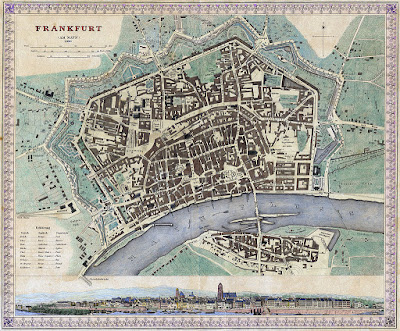
After his period in Berne in Switzerland, Hegel returned to his family
in Stuttgart where, we have it from his sister, he was withdrawn and
morose. He then proceeded on northwards up to Frankfurt, hoping for more
leisure, books and stimulating companionship. He stayed with a merchant
family the Gogels in the Roßmarkt – I daresay the RAF bombed this flat
in the war, but I think Goethe’s house survived, so you never know.
Rosenkranz points out that the same town was the cradle both of Goethe’s
poetry and Hegel’s philosophy. However, it appears later that he
misallocates some texts from the Jena period to Frankfurt, so that
conclusion is not quite sound. Nor is his conclusion that Hegel did
indeed have more leisure in Frankfurt for the same reason, though it may
be true nonetheless. The fact that his sister’s view is not corroborated
might allow for a more favourable view of the Berne period too, but I am
told that the Berne period has been investigated on its own account
subsequently.
In Frankfurt, says Rosenkranz, Hegel’s speculative talent took wing and
his political ambitions were kept alive. However, again the
misallocation of texts casts doubt on the former of these assertions.
Politically, a friend died at the battle of Wagram fighting Napoleon in
a Hessian regiment.
Hegel met Hölderlin again and witnessed his “catastrophic” affair with
Suzette. He also met a Herr Sinclair who expressed concern about the
subjectivity of idealism. He also met many other people who are less
remembered. Sinclair later expressed his ideas in a book Truth and
Certainty (1811). Hegel was receptive to such “Christian romanticism”
as Rosenkranz describes it. I don’t think Sinclair has ever been much
discussed in English.
Rosenkranz describes Hegel’s thought as having moved on from rationalism
and Fichte to a “speculative mysticism” at this time. Again the apparent
misdating of texts vitiates the reliability of this conclusion. Hegel
spoke of Ceres, goddess of grain (fertility) in his early poem Eleusis
and now
turns to nature-poetry. In one striking image, he says “spring
menaces.…”; and in another that nature in winter is in mourning. This
perhaps presages his willingness to read meanings into natural
phenomena, though of course it doesn’t justify it.
Chapter 17 - Political Studies
Rosenkranz summarises Hegel’s political experience at this time by
noting that he was from a civil service family and had seen a university
town at Tübingen and then a patriarchal hereditary aristocracy at Berne.
Frankfurt in contrast, was run by a monied merchant aristocracy. Hegel
admired the (mixed) English constitution, as was then common, and also
the development of commercial relations there. He followed debates on
the English poor law in journals (R doesn’t mention which ones, which is
a shame as they’re mostly available online these days) and the Prussian
civil code. He also knew of arguments on penal sanctions including
solitary confinement. (If I might interject here,
this is very probably a reference to the English prison reformer Howard,
who sought to reform prisons by instituting solitary confinement, which
proved worse for prisoners than some of the punishments it replaced,
though it was well-intended.)
In Frankfurt, Hegel wrote a commentary on Steuart’s Principles of
Political Economy (1767) using the German translation (Tübingen,
1769-72). Osmo says this commentary is now lost. It is important that
not all Hegel’s writings have come down to us and Rosenkranz is a
valuable source of information on the lost material. For example, this
lost commentary justifies Laurence Dickey’s use of a comparison with
Steuart that is also developed in Paul Chamley's Economie Politique et
Philosophie chez Steuart et Hegel (Paris, 1963). It suggests to me that
Hegel was perhaps out of step with the main line of liberal thought on
the subject deriving from Adam Smith. The lost commentary addressed
several aspects of civil society that reappear only in the Philosophy
of Right (1821), including:
- division of labour
- state power
- poor relief and police
- taxation.
There also dates from this time summaries of Kant’s Critique of
Practical Reason (1788) and Kant’s other late legal and moral writings
(i.e. the Metaphysic of Morals). As in his later published views,
Hegel thought there was an original unity of morality and positive law
which he expressed by the terms Leben (‘life’) and Sittlichkeit
(usually translated as ‘ethics’). He disliked the degradation of nature
implied in absolutism of Kant’s morality of duty. He also takes issue
with Kant’s doctrines of law and morality that leave state and church
mutually independent. For Hegel the church is all-encompassing and to
see church and state as unrelated is simply not to take one of them
seriously. (If I might interject here, this strikes me as completely
mistaken as it confuses a principled refusal of the church to operate by
force with a lack of seriousness. This was a live issue in much of
Europe at this time.)
Also in the Frankfurt period, Hegel worked on an essay on ‘The German
Constitution’. Here he vaguely contrasts an indeterminate outward hope
with an enduring outward political reality that is inadequate to it. The
German emperor has ceased to be a source of law (‘Recht’) and has
declined to a particular amongst particulars; whereas the character of
law is to be universal. This universal in Germany is thus present only
as thought, not as effective reality. (To interject again: this was
translated by T.M. Knox and if I recall rightly also contains quite a
bit of empirical material.)
Finally, Hegel also wrote in a more practical political vein an essay
‘That the Württemberg Magistrates should be elected by the People’.
However, friends suggested revisions and then advised against
publication. Rosenkranz describes him as wavering between Plato and
Rousseau (I’m note sure what that means). He evokes general images of
hypocrisy setting aside justice through self-interest – that sounds
like the sort of youthful idealism that he later characterised in
‘Virtue and the Way of the World’. However, the text has been more
adequately commented on elsewhere, so I will hold my horses.
Chapter 18 - Return to the Critique of Positive Religion
In 1799 and 1800, politics gives way again to religion in Hegel’s
thoughts, but this time in a more moderate spirit in which there is a
role for ‘positivity’, which is to say for the intrusion of outward fact
in the form of both traditional doctrinal content and public expression.
The precise autobiographical validity of this chronology has since been
subject to doubt owing to questions over the dating of texts, however, I
here recite the story as presented by Rosenkranz. The main text he deals
with is in fact dated.
Hegel thus now takes the standpoint of a ‘philosophy of religion’ within
which the concept of religion is developed and in the light of which its
historical expressions are interpreted. Rosenkranz cites the
‘system-fragment’ of 1800 to back this up. This was later published by
Hermann Nohl in Hegels Theologische Jugendschriften (1907) and is
available in English at the back of TM Knox’s Early Theological
Writings (1948).
Hegel’s concept of religion now goes something like this: we place God
outside ourselves and relate to him, though LOVE, as of something
infinite, unified and alive. The finite as LIFE (I capitalise some of
the key terms) thereby raises itself above oppositions and thus sees or
discerns the infinite. Hegel’s vocabulary here validates (practical,
mental) ‘life’ as a basic context in which concrete concepts arise and
make sense. Here, continues Rosenkranz, even the oppositions of life (in
the limited biological sense) and death, or of thought and
what-is-thought must be abandoned; the true infinite is not to be held
at a distance as one term in an opposition that WE have conceived. At
this point Hegel opposes reason (that holds onto the infinite) and
understanding (that draws distinctions). Rosenkranz describes this
description of Hegel’s as an ‘abstract characterisation’ of religion.
Developing the theme of ‘positivity’ (outwardness), Hegel now thinks
that religion needs an ‘objective focus’ (culte/cultus) – as e.g. in a
temple – that is connected to a subjectivity (that is, a religious
consciousness imbued with the significance of the outward facts of
ceremony, etc). The conditions of religion, he says, are to be freed
from ‘absolute objectivity’ and the concerns of finite life. In this
context, the meaning of SACRIFICE consists of a giving up of the finite,
setting nothing finite aside as real. In addition to this, what is not
sacrificed loses its particularity by being SHARED. (If I might
interject here, the theme of ‘sacrifice’ is often noted as something
assumed and pmnipresent in the ancient world, from Abraham to that
Greek bloke who sacrificed his daughter Iphigenia at the start of the
Trojan war to the Atonement itself - on some interpretations. Even we
speak of ‘sacrificing ourselves’ to a goal, which is both the same and
different to my mind. In addition, Hegel’s insightful interpretation of
sharing was new to me and seems highly plausible.)
Song, dance and joyful feeling bring subjectivity into play. Hegel here
cites phrases from Fichte’s Appeal to the Public (1799), the essay
that ended his tenure at Jena; and also the lines ‘What the heaven of
heavens does not encompass finds its place in Mary’s heart.’ This text
(the system-fragment) is dated September 1800.
The chapter includes in this mystical way with the observation that ‘the
infinite is not the totality of the finite’ (for that is only a ‘finite
infinite’, so to speak). This sounds like the sort of thing Bob Wallace
sometimes says and sounds like a significant development of the ideas
both of infinity and totality, both of which are fairly key for Hegel
sating back to his ‘hen kai pan’ (all and one) days.
The next chapter is particularly interesting and much longer than the
others. More on it to follow.
Discussion of chapter 14 in the hegel.net list
[SC:]
I partially reproduce here some comments from Beat Greuter on Carl
Bachmann occasioned by my chapter 14 above under creative commons licence at the hegel.net hegel list
and my reply in acknowledgement:
[Beat Greuter:]
["Bachmann wrote a book on "System der Logik" (1828) based on
Aristotelian logic. After Hegel's death he wrote another book "Ueber
Hegel's System und die Notwendigkeit einer nochmaligen Umgestaltung der
Philosophie" (1833) where he repeated that the system of philosophy by
Hegel has not yet come to an end. [.…] It is very interesting that
it was just Karl Rosenkranz - 10 years before he wrote his Hegel
biography - who replied to Bachman's "Über Hegel's System und die
Notwendigkeit einer nochmalige Umgestaltung der Philosophie". Bachmann
was at this time - what an irony of destiny - a professor for philosophy
at the university of Jena while Rosenkranz had the same position in
Königsberg, one of Kant's successor. Rosenkranz entitled his reply a
"Sendschreiben an den Hofrath und Professor der Philosophie, Herrn Dr.
Carl Friedrich Bachmann in Jena" (1834). [.…] On the following
website you can find the Google books written by Bachmann. I do not
think that there are English
translations.]
[http://www.google.de/search?tbs=bks%3A1&tbo=1&q=Carl+Friedrich+Bachmann&btnG=Nach+B%C3%BCchern+suchen]
[I also find out that Bachmann's "Anti Hegel" (1835) was an answer to]
[Rosenkranz's "Sendschreiben" I mentioned before. [.…] "]]
[Stephen Cowley replied:]
["Many thanks for the corrections and supplementary information. Pierre
Osmo gives a certain amount of information about Karl Friedrich Bachmann
(1785-1855) who is mentioned several times in Rosenkranz’s book. In
addition to citing the comparison with Aristotle, Rosenkranz
particularly mentions Bachmann as one of 30 students attending Hegel’s
Winter 1804 course in Jena that covered his whole system. He later notes
Hegel’s gratitude for Bachmann’s early positive account of the
Phenomenology in the Heidelberger Jahrbücher (1810). In 1858 in his
reply to Haym, Rosenkranz also names Bachmann as one of five protestant
polemicists which Osmo takes to refer to his book ‘Anti-Hegel’ (1835)
which provoked a reply from Feuerbach as his earlier one did from
Rosenkranz himself. ]
[All this adds to my knowledge of the richness of early German reactions
to Hegel. Bachmann’s use of ‘formal logic’ sounds similar to the early
work of Trendelenberg on Aristotle that took an anti-Hegelian line.
Frege comes at things from a more abstract, Meinongian angle, as far as
I remember. Rosenkranz’s own view (which I will come to later) is that
mind is a central concept for Hegel with propositional thinking an
offshoot of this. Bachmann seems to have moved from comparing Hegel with
Aristotle on the grounds of his interest in worldly matters of fact to
contrasting him with Aristotle for not doing justice to the meaning of
fixed terms – but as I don’t have access to the original texts I can’t
usefully comment further." ]]