Руководство по hegel.net
About us:
Our mission statement can be found here
How to use the Hegel.net site:
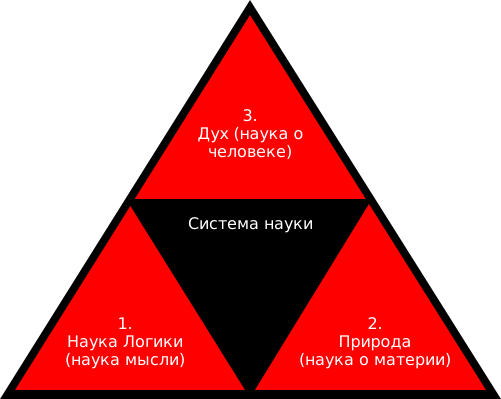
With the large triangle you can move through the scientific universal system of Hegel: Click on the center of the triangles = move one level higher. Click on one of the 3 side triangles = move one level deeper.
Eight colors mark the different levels. At the ninth step, the colors start repeating.
Question marks and square braquets indicate expansions that we made.
The middle of the triangle is the current topic.
Right beside the triangle you find the function “contributions”, clicking on it leads you to the “article list” on which all contributions are systematically listed.
Pressing the “F11” key on the keyboard (in most Browsers like MS IE/Edge, Fireox, Google Chrome) changes the site display to the complete screen size (and back).
Feedback, Help:
We like to hear your Comments, Questions, Articles etc! Please tell us, when you see errors or typos! We need your help to correct our translation! When in doubt, please consult the German version.
Who is behind this
Responsible for these pages is Kai Froeb in São Martinho do Porto, Portugal. Full details are given in the imprint.
Around fifty authors have contributed articles, along with translators, correspondents and readers whose questions became texts. They are listed, with their own pages where available, in the directory of people.
What you may do with the contents
Reading, printing, using in class, quoting — the essentials are permitted and cost nothing. The details, including the question of machine access and AI training, are set out in the terms of use.
How personal data is handled is set out in the privacy notice.
If you notice something
Errors, dead links, wrong information: write to info @ hegel.net. The same applies if you believe a right of yours has been infringed — anything that proves justified will be removed or corrected.
Why it is not a Sierpinski triangle
At first glance the figure looks like that well-known fractal: a triangle dividing into three smaller ones, and those again. One difference only becomes apparent on closer inspection — the three sub-triangles are enclosed by a frame bearing the colour of the larger one.
This is not decoration. It says that what encompasses continues to exist within its parts: logic is not alongside being, essence and concept, but within them. The Sierpinski triangle has no such frame, and its parts merely stand side by side.
The form of the triangle was designed by Stefan Sy; a poster of the first five levels is still available.